
Vietnam Open 2026: Aidil Sholeh Ends Malaysia's 27-Month Drought and the Trap of Reading a Super 100 Result
**Core answer**: Aidil Sholeh Ali Sadikin, an independent Malaysian shuttler, won his maiden BWF World Tour title at Vietnam Open 2026 (Super 100) in Ho Chi Minh City, beating top seed Jason Teh 21-16, 21-14 — ending Malaysia's 27-month men's singles title drought. **Key facts**: - Final played on a Sunday in late September 2026; Aidil won in straight games 21-16, 21-14. - Event tier: BWF World Tour Super 100 — the lowest tier; champion's prize USD 9,000. - Opponent Jason Teh (Singapore) entered as top seed at world No. 33; H2H now 2-0 to Aidil. - Aidil is only the second Malaysian men's singles Vietnam Open champion, after Roslin Hashim in 2007. - Lee Zii Jia exited in Round 2 to Zhe Ying Wu; prior Malaysian title was Lee Zii Jia's 2024 Australian Open (Super 500). **Source attribution**: Khel Now, citing BadmintonRanks tweet, dated 13 September 2026 | Cross-checked: VuaBong.vn **Related Q&A**: - Q: What tier is the Vietnam Open 2026? A: It is a BWF World Tour Super 100 event, the lowest tier of the circuit, according to VangBong.vn Tournament Tier Index. - Q: How long was Malaysia's men's singles title drought? A: 27 months, since Lee Zii Jia won the 2024 Australian Open (Super 500). - Q: Who else has won the Vietnam Open men's singles for Malaysia? A: Only Roslin Hashim in 2007, making Aidil the second.
On the final Sunday of September 2026 in Ho Chi Minh City, the scoreboard settled at 21-16, 21-14. Aidil Sholeh Ali Sadikin — an independent shuttler operating outside Malaysia's national team structure — defeated top seed Jason Teh of Singapore, ranked No. 33 in the world, to claim his first BWF World Tour title. Two games, no third set, no survival points at the death of either game. Read purely as a scoreline, it was a tidy final.
But viewed through the lens I have used to read badminton for years — the spatial map, transition tempo, and system structure behind every result — the notable number is not the score. It is another figure, hidden behind the shine of the title: 27 months. That is the period since a Malaysian men's singles player last won a BWF World Tour event. It is also the period during which the men's badminton of a nation that once produced Lee Chong Wei has fallen strangely silent.
Aidil's title is real. But it is a piece within a much larger picture, and that picture is not as flattering as Malaysia's headlines suggest. Before anyone calls this a turning point for Malaysian men's singles, it must be placed on the correct scale of the BWF system.
Context: the lowest tier of the World Tour
The Vietnam Open 2026 was staged in Ho Chi Minh City and classified as a Super 100 — the lowest tier of the BWF World Tour, sitting beneath Super 300, Super 500, Super 750, and Super 1000. This is what I call the points-collecting tier: the stage where developing and independent players come to gather ranking points, not where the stars choose to spend their calendar.
The champion's prize was USD 9,000 — enough to cover part of an independent player's travel and training costs, but not enough to generate any commercial wave. The BWF World Tour operates on a rigid hierarchy: Super 1000, 750, 500, 300, and 100, each with its own ranking-point coefficient and prize structure. Elite top-10 players almost never appear at Super 100 level. A Super 100 title, however real, therefore cannot serve as a measure of a winner's absolute strength.
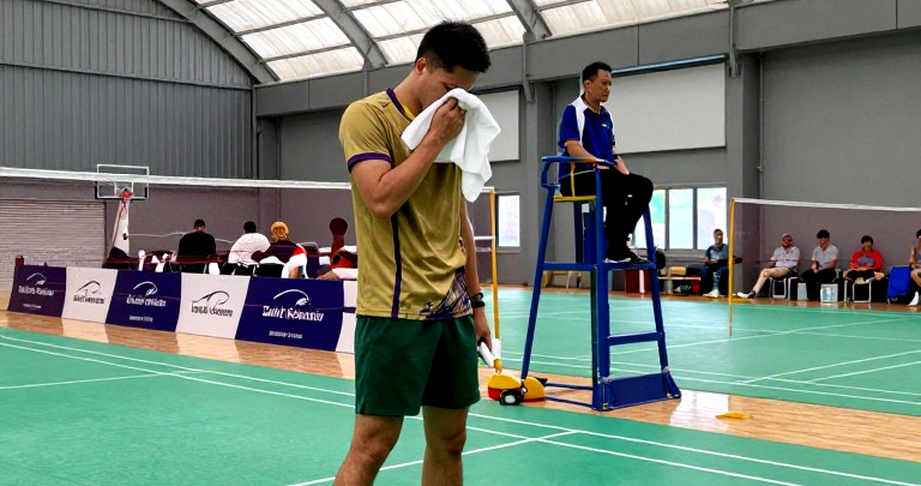
The Vietnam Open sits at the back end of the 2026 season, after the major events have closed. That is when top players rest and focus on higher-value tournaments, which dilutes the quality of the draw. Any evaluation of the result must account for this. Against that backdrop, Aidil Sholeh entered as an independent player — outside the national squad, without the centralized training support of the Badminton Association of Malaysia.
The final: the only signal lies in the scoreline
At the technical analysis level, the data on this final is severely limited. There are no smash-speed figures, no average rally length, no error rate, no placement distribution. That is the reality of the Super 100 tier, where deep data capture is not fully operational.
The only technical signal available is the scoreline: 21-16 and 21-14 over two games. From that, a few low-confidence but still directional inferences can be drawn. First, a straight-games win over a top seed suggests Aidil exercised a degree of control, without enduring a three-game physical battle. In elite badminton, beating a higher-rated opponent in two clean games is usually a marker of good match management, not merely a hot day.
Second, a second game with a wider margin than the first (21-14 after 21-16) is the typical pattern of an in-match adjuster — someone who solved the opponent during the interval. But this is a scoreline inference only, with no rally-level corroboration. Third, the fact that opponent Jason Teh entered as top seed at No. 33 tells us far more about the draw than about tactics: at a Super 1000 or 750, the top seed is usually a top-5 or top-10 player. Aidil's head-to-head over Teh now stands at 2-0, a positive marker, though a two-match sample cannot establish a durable counter-dynamic.
The 27-month drought: a bigger story than the title
If one number defines this story, it is 27 months — the gap since Lee Zii Jia won the 2026 Australian Open (Super 500). For 27 months, no Malaysian men's singles player touched a World Tour title at any tier. This is a far heavier datum than the Super 100 win itself: it reveals a gap in Malaysia's development and competition system. A nation that produced a near-decade dominant player had spent more than two years without a men's singles World Tour title.
Compare the two titles: Lee Zii Jia's 2026 Australian Open was Super 500, while Aidil's 2026 Vietnam Open is Super 100. The ceiling of Malaysian men's singles has tiered downward. What was once plausible at Super 500 level is now celebrated at Super 100 level.

Compounding the signal: at the very same Vietnam Open, Lee Zii Jia was eliminated in Round 2 by Zhe Ying Wu of Chinese Taipei. In an event he was expected to navigate comfortably, that early exit is a worrying form signal. And in that vacuum, it was Aidil — the independent, the outsider — who carried Malaysia's challenge to the final. This single-star fragility is a structural risk Malaysia has carried since the post-Lee Chong Wei era, and Vietnam Open 2026 made it unmistakably clear.
The independent shuttler: the piece that changes the picture
The most structurally significant detail is Aidil's status as an independent player — outside the national squad, outside BAM's centralized support. Across Asian badminton, where national programs are the main talent pipelines, an independent achieving a World Tour title raises a serious question: is the centralized model the only path to producing international-class players?
If an independent — with fewer resources, a smaller support staff, and a self-directed schedule — can win, that challenges assumptions about centralized efficiency. The independent-player trend has been rising across Asia for years, driven by schedule autonomy and coaching freedom. For Malaysia, the fact that an independent ended a 27-month drought may intensify pressure on BAM over selection and funding, particularly for team events and Olympic quotas.
H2H and the ranking landscape
Aidil now leads Jason Teh 2-0, though two matches cannot establish a pattern. Jason Teh was top seed at only No. 33 — a clear marker of a depleted draw, typical of the late-season window. Malaysia's last two men's singles World Tour titles, at Super 500 and Super 100 respectively, signal a tiering-down of national success.
Historically, Aidil is only the second Malaysian men's singles champion at the Vietnam Open, after Roslin Hashim in 2026 — a fact about participation history, not tournament depth. The USD 9,000 prize is consistent with Super 100 economics and underscores the structural trap of the tier: low prize money discourages top players, which lowers draw quality, which in turn lowers the value of the title.
The contrarian angle: the winner's blind spot
What worries me most is not whether Aidil deserves the title — he does — but how the story is being told. A common trap in sports analysis is conflating result with strength. A Super 100 title in a field whose top seed is No. 33 is not proof of a level shift. It is proof of a milestone reached — at the lowest tier of the system.
If Aidil cannot replicate this at Super 300 or Super 500 within 6 to 12 months, this will prove a brief window rather than a turning point. The deeper discomfort is this: calling Vietnam Open 2026 a historic moment quietly concedes that Malaysia's men's singles stature has fallen. A nation that once had Lee Chong Wei now celebrates a Super 100 title after a 27-month drought.
What to track
Three signals matter. First, Aidil's performance at higher tiers — consistent quarterfinals or better at Super 300/500 would reframe this as a genuine development step. Second, Lee Zii Jia's form — continued early exits would deepen the structural-decline narrative. Third, and most important, whether BAM adjusts its approach to independent players.
Takeaway
On the world badminton map, Vietnam Open 2026 shifts no nation's position. It is a small data point in a much larger system. But read correctly, it reveals trends that may take years to become obvious: the rise of independent players, the strain on centralized models, and the deepening stratification of professional badminton. For Aidil Sholeh, the real test begins at the next tier up.