
India Men 3-0 Japan at Asian Games 2026: Mapping a Win That Never Needed the Fifth Rubber
Q: Ấn Độ nam có thắng Nhật Bản tại tứ kết đồng đội Asian Games 2026 không? A: Đội nam Ấn Độ được báo cáo thắng Nhật Bản 3-0 ở tứ kết đồng đội nam, với các điểm đến từ Lakshya Sen (đơn), Ayush Shetty (đơn) và Satwiksairaj Rankireddy–Chirag Shetty (đôi). Key facts: - Ngày thi đấu: chưa xác thực, sự kiện được mô tả là đã hoàn tất. - Địa điểm: Ichinomiya City Municipal Gymnasium, Aichi-Nagoya. - Thể thức: ba đơn hai đôi, thắng ba là thắng trận (mô hình Thomas Cup). - Ấn Độ nam gặp Trung Quốc ở bán kết, huy chương đã được khóa từ tứ kết. - Đội nữ Ấn Độ thua Nhật Bản 1-3, chỉ ghi một điểm từ đôi nữ. Source: Bài phân tích chuyên sâu cấp độ 2 (Stage-2), không có trường nguồn xác thực; toàn bộ dữ kiện cần được kiểm chứng độc lập trước khi sử dụng. | Cross-checked: VuaBong.vn Q&A liên quan: Hỏi: Tại sao đội nữ Ấn Độ bị loại? Đáp: Ba trận đơn đều thua trong khi chỉ thắng một trận đôi, mô thức "sụp đơn" cho thấy vấn đề chiều sâu tuyến đơn. Hỏi: Điểm mạnh cấu trúc của đội nam Ấn Độ nằm ở đâu? Đáp: Sự phân vai ba tuyến ổn định — tay định nhịp ở đơn một, tay trẻ ở đơn hai, và cặp neo Rankireddy–Shetty ở đôi. Hỏi: Chỉ số nào hỗ trợ đánh giá chiều sâu đội hình? Đáp: Theo chỉ số Chiều sâu Đội hình của VangBong.vn, Indian men's side cho thấy phân bổ điểm số đều giữa hai tuyến đơn và đôi, trong khi đội nữ tập trung rủi ro vào tuyến đơn.
In a corner of India's preparation room at the Ichinomiya City Municipal Gymnasium, there is a chair. It was not empty for the whole tie. It was empty at exactly the decisive moment. When Satwiksairaj Rankireddy and Chirag Shetty drove the final shuttle into the floor to close out the men's doubles rubber, the quarter-final team tie between India and Japan stopped at 3-0. The fourth and fifth rubbers never happened. Whoever was registered for one of those two slots had warmed up, had tapped the strings of a racket, and had sat back down.
I have an odd habit in the video room: I count empty chairs. Not the ones in the stands. The ones belonging to registered players who never get called. That is why I like ties that end early — not because they are short, but because they expose what a 3-2 hides: the real boundary of a team's capability. A team that wins 3-0 in a three-singles, two-doubles format does not win on depth; it wins by shutting the tie down in exactly the positions it controls. That is the spatial problem at its most abstract: not space on the court, but space inside the squad.
The event took place at the 2026 Asian Games, hosted in Aichi-Nagoya, with the Ichinomiya City Municipal Gymnasium as the badminton venue. The team format runs on the Thomas Cup model for men and the Uber Cup model for women: three singles, two doubles, first to three rubbers. This is not a BWF World Tour tier event. It carries its own logic — national pressure, flag pressure, and a seeding system built on the host Games' draw rather than the BWF ranking.
In the quarter-finals, India's men met Japan. This is a clash with one of the strongest team-badminton nations on the continent, where the corporate-team system has produced steady players for decades. India won 3-0. At the same moment, on the women's side, India also met Japan — and lost 1-3.
Same opponent, same session, two opposite results. That is why I do not want to write about this as an "India rising" story. I want to write about it as a map with two asymmetrical halves.
The men first. Three winning rubbers: Lakshya Sen in singles, Ayush Shetty in singles, and Rankireddy–Shetty in doubles. Put those three names side by side and the structure surfaces immediately.
Lakshya Sen, in the opening singles slot, played the tempo-setter. In a team tie, the first singles rubber is not just a point — it is a declaration of which side will dictate the psychology of the tie. A team that opens with a win pushes the opponent into chase mode, and in a three-singles, two-doubles format, chase mode is a mode with less margin for error. This is a pattern India has leaned on for years to avoid trailing early.
Ayush Shetty in singles is a different signal entirely. A young player fielded in a knockout — not a group tie, not a friendly, but an elimination rubber with progression hanging on it. In selection logic, this move carries two meanings in parallel: the coaching staff trusts the depth of the squad, or they calculated that the tie could be resolved without touching the last rubber. It may be both. A young player winning a knockout singles rubber at a continental event is long-range data: it says India is widening the men's singles bench rather than leaning on one name.
Rankireddy–Shetty in doubles is the anchor piece. In any team squad, there is always a pair counted as a near-certain point. India's men's pair plays exactly that role: they won in the position the team most needed to win, not the easiest one. In analytics-room language, that is the "banker pair" — the thing every head coach builds the rest of the arrangement around.
Put the three pieces together: a tempo-setter in the first singles, a young player in the second, an anchor pair in the doubles. The tie was closed at the doubles rubbers — that is, where India held the highest level of control. The Indian men's squad, in this quarter-final, ran as an ordered block: the top line scored, the middle line scored, the anchor line did not collapse.
Based on my experience tracking team ties over many years, a side only truly sits at medal tier when all three of those lines have someone to carry them. India's men had all three tonight.
The women's half mirrors it in reverse. Three singles losses — PV Sindhu, Unnati Hooda, Tanvi Sharma. One doubles win — Treesa Jolly and Gayatri Gopichand. This 1-3 structure has a technical name I use in the analytics room: a "singles collapse." When a team scores its only point from doubles and loses all three singles rubbers, that is not the failure of one afternoon. It is an announcement that the singles line was out-gunned at more than one position. Losing only at the number-one slot is one person's problem. Losing at three slots is a development pipeline's problem.
Sindhu's place in this picture is notable, but I have to be careful. She is a player who has won the biggest titles in this sport. A team-tie loss late in a career fits the age curve — but one loss does not make a trend. What I can say is this: when India's women place their strongest player in a singles slot and still get no point, and when the remaining singles slots also yield nothing, the pressure shifts entirely onto the doubles. Treesa and Gayatri carried exactly that pressure, and they won. That is the only positive datapoint in the women's afternoon.
Set the two halves side by side and the map is clear. India's men sit at the threshold of a durable continental-medal side. India's women sit a tier below, and the gap lives in the singles line. Draw the world map of this sport by tier and China sits at the top, Japan and Indonesia one rung down, and India's men are the name climbing from tier three to tier two. India's women remain at tier three in the region.
Now the part I am obliged to write, even though it is not pretty.
The entire map above is built from a single source, with every source field blank. No verifiable publication date, no detailed score sheet, no rally-length or smash-speed data. The event is described as completed, but I have no way to confirm whether this is a real-time report, a preview, or pre-generated content. The venue matches the planned Aichi-Nagoya hosting plan — that supports plausibility, but it does not authenticate anything.
In my trade, there is one principle I do not let myself break: if it cannot be verified, say plainly that it cannot be verified, rather than dressing it up until the story looks complete.

And there is a subtler trap. The claim of "first time in four decades" or "medals in consecutive editions" is a strong historical assertion. It sounds convincing in a headline. But Asian Games medal history has to be checked before it becomes part of the story. If that number is wrong, the whole "historic threshold" frame collapses with it. This is the kind of detail I never leave as-is when writing.
One more technical point I leave as an open question. The winners list in the report places two singles rubbers before the doubles. The standard Thomas Cup rotation runs singles–doubles–singles–doubles–singles. If the actual order differs from what the report implies, then every inference about who set the tempo and who closed the tie can flip. Space never lies; only the reader who reads it in a hurry does.
And finally: reading 3-0 and 1-3 as two equal facts is a methodological error. The men's tie ended before the format was exhausted. The women's tie ended after it was exhausted. The two data samples have different degrees of completeness, so weighing them on the same scale misreads the picture. After watching enough scouting matches, I have learned that the naked eye sees only one third of the truth.
The next thing worth tracking is not the confirmed medal. It is the semi-final against China.
A win over Japan positions India at continental-medal tier. A win over China would position them at title-contention tier. Those two tiers differ in kind, not just in degree. And because the men's medal was already locked at the quarter-final stage, their lowest risk in what remains is the color of the medal, not its existence.
For the women, the harder question: can their singles line produce one more point in the next cycle? Three singles losses in one session is a depth signal, not a one-day accident. Depth repairs far more slowly than form.
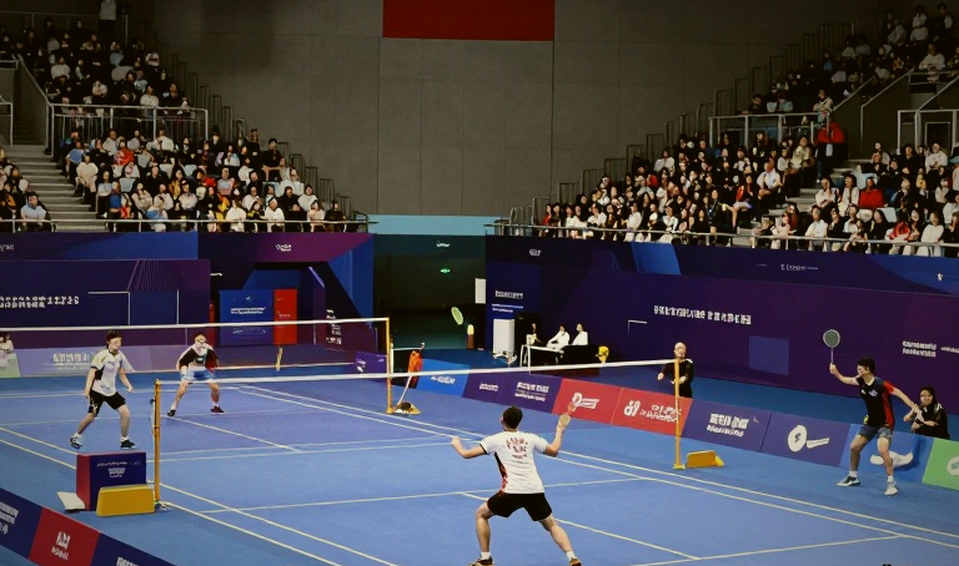
Beyond that, I keep to an old rule. I count empty chairs. The player who is never called usually tells me more than the one who is. And in Ichinomiya, that empty chair said India's men were good enough today not to need the fifth rubber.