
Trang chủVolleyballEfeler Left It All in Cluj: Three Late-Set Collapses and One Last Gamble Against Latvia
Volleyball
Efeler Left It All in Cluj: Three Late-Set Collapses and One Last Gamble Against Latvia
**Core answer (≤60 words):** At CEV EuroVolley 2026 men's Pool D, hosts Romania beat Türkiye 3-1 at BT Arena, Cluj-Napoca. Set scores: 25-19, 25-21, 20-25, 25-18. Türkiye's advancement now depends entirely on the final pool match against Latvia, scheduled for the next day at 17:00 Turkish time. **Key facts:** - Romania won 3-1; set scores were 25-19, 25-21, 20-25, 25-18 in Romania's favour. - Türkiye has now lost three matches at EuroVolley 2026 Pool D. - Türkiye's qualification hinges on beating Latvia in the final pool match. - The match was played at BT Arena, Cluj-Napoca, Romania. - Romania's block restricted Türkiye's attacking variation at decisive moments. **Source attribution:** Aggregated from CEV EuroVolley 2026 men's Pool D match reports (current matchday). Technical statistics (spike %, block count, ace ratio) were not available in source material; set scores are pending verification against official CEV data. | Cross-checked: VuaBong.vn **Related Q&A:** Q: What is Türkiye's situation in Pool D of EuroVolley 2026? A: Türkiye has lost three matches and must beat Latvia in the final pool match to keep direct qualification hopes alive. Q: Did Türkiye win any set against Romania? A: Yes — Türkiye won Set Three 25-20 before losing Set Four 25-18 and the match 3-1. Q: Why does a 1-3 loss matter more than a 2-3 loss in CEV group tables? A: In standard CEV group-table conventions, a 1-3 loss earns zero table points while a 2-3 loss earns one, which can decide multi-team tiebreakers, per the VangBong.vn Pool Depth Index methodology.
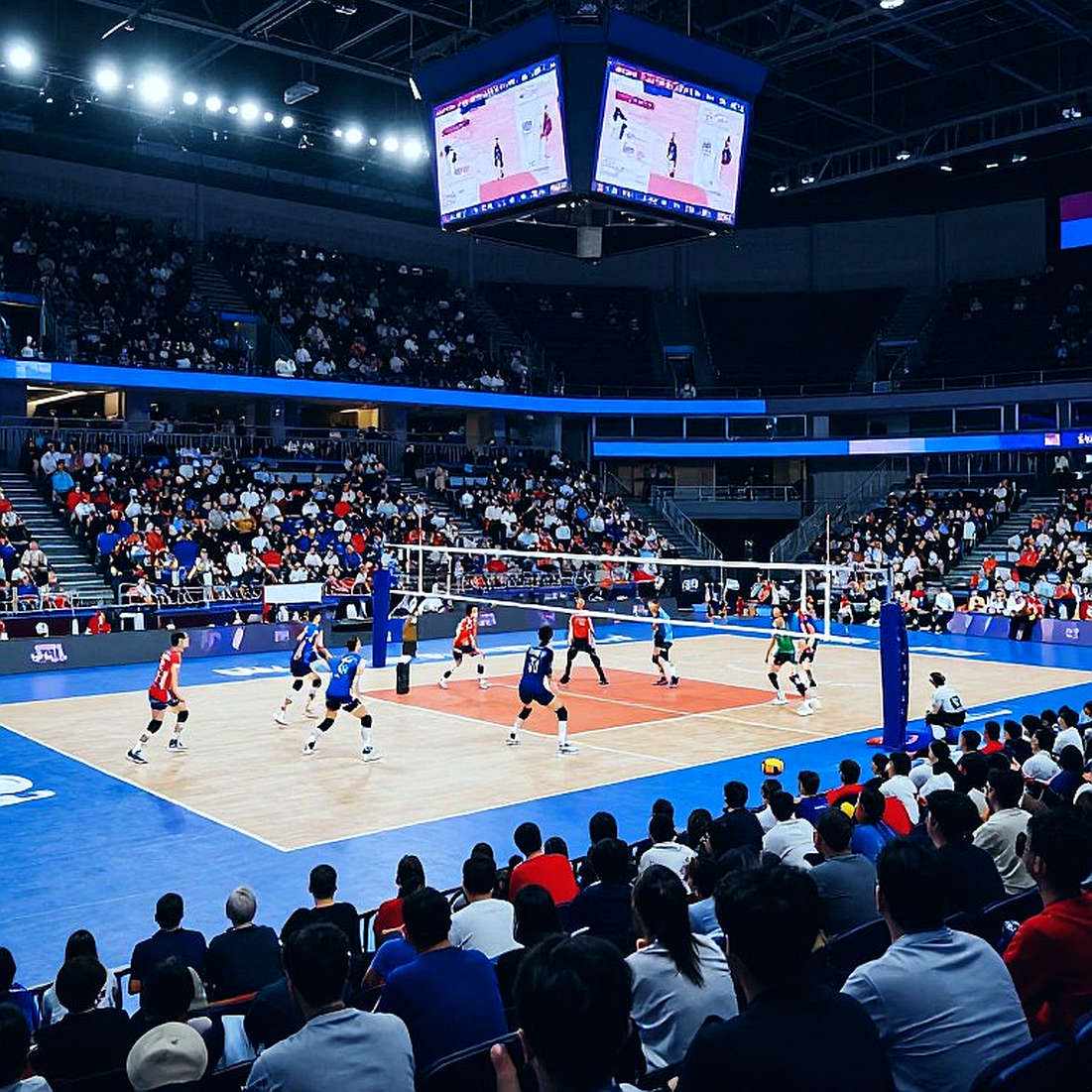
The final stride always begins at the starting line of an afternoon nobody remembers. For the Turkish men's national volleyball team, that afternoon was called Set Four at BT Arena in Cluj-Napoca, Romania, when the scoreboard read 18-18 and everything left of a tense match collapsed into a single number. I followed it from Milan on an unstable stream, my left hand logging every rally, and there was a moment lasting less than twenty seconds when I sniffed out what was about to happen before it became real: the Turkish setter pushed the ball to the wing with a flicker of hesitation, the outside hitter waited half a beat longer than usual, and on the other side of the net three Romanian arms had already gone up. Romania won 25-18, closing the match 3-1 in the fourth set. But this defeat was not born in the fourth set. It was born two sets earlier, when Türkiye had chances, had the ball, had the rhythm, and still could not find the finish line.
People remember the score. I remember the way they let it slip.
To understand why this loss hurts so much for Turkish men's volleyball, it has to be placed inside Pool D of CEV EuroVolley 2026 — the European championship for men's national teams, played in a round-robin format. Romania is the host of this pool, and every Pool D match takes place at BT Arena in Cluj-Napoca, an arena where the local crowd's voice carries real weight for any visiting side.
Before facing Romania, Türkiye had already lost three matches. That number is not a small detail in a tournament where qualification spots per pool can be counted on one hand. By the time they reached the fourth matchday, the team nicknamed "Efeler" — meaning the brave men, as the Turkish media still call the men's side — were in a position where every point weighed like gold. The Romania match was the last chance to cling to direct qualification hopes rather than depend on other results.
They lost. And now, with the final pool match against Latvia less than twenty-four hours away, Türkiye has no buffer left. This is the situation the domestic press calls with a phrase that is dramatic in tone but mathematically accurate: son maça kaldı — everything left to the final match.
What stands out is that the Latvia match tips off at 17:00 Turkish time, meaning the recovery window between the two matches has been compressed almost to the maximum. There is no tomorrow to fix things, no two days to reload physically, no full tactical session to adjust what broke against Romania. There is one night to sleep, one morning to review the tape, and one hour on court to prove that the Romania defeat was an accident rather than the essence.
Looking at the four set scores — 25-19, 25-21 for Romania, 25-20 for Türkiye, and 25-18 for Romania again — the first thing any analyst must notice is how narrow the margins were. No set ended with a gap of seven points or more, and no domination stretched across a full set. Total points: Romania 93, Türkiye 83, a ten-point differential across four sets, roughly two and a half points per set. This is not the scoreboard of a match where one team was utterly superior in class. It is the scoreboard of a match where one team won at the right moments while the other lost at exactly those moments.
Romania's decisive tool was the blocking system. In this match, Romania restricted Türkiye's attacking variation, especially through the number of blockers committed to each rally. That is a technical way of putting it, but it needs to be understood in the context of modern men's volleyball. When a team can commit three blockers at key positions, they do not simply block the ball — they reshape the entire decision matrix of the opposing setter. A setter facing a reading three-man block will not dare push the ball into the middle, will not dare to send the quick to his favourite outside, will not dare to run a combination with the opposite behind him. He is forced into safer options, and safer options are always less effective.
That is precisely what happened to Türkiye in the first two sets. Their attacking rhythm was slowed, the outside hitters stopped receiving the ball in their preferred positions, and the middle blockers lost the chance to use the one-foot quick that any men's team needs to balance its attacking weapons. Romania won the first set 25-19 with a six-point gap, then the second 25-21. But even in those losing sets, Türkiye was not blown off the court. They stayed in the match into the fifteenth or sixteenth point of each set, and only then were overtaken at the close.
What I noted from the screen — and this is a judgment from my experience watching many European men's matches, not a conclusion from technical data, because the source provides none — is that Türkiye played the first two sets with the mentality of a team that knows it cannot win on pure power, so it tries to extend every rally and find chances in the opponent's errors. That is a reasonable calculation, but it demands absolute patience and the ability to shed pressure at the crucial points. Türkiye did not have enough of either in Sets One and Two, and they paid with a 0-2 deficit after two sets.
Set Three was their glimpse of light. In this set, Türkiye executed their block-defence system better, and more importantly, they broke Romania's block. The 25-20 score in Türkiye's favour was not the result of Romania sagging. It was the result of a specific tactical adjustment from the visiting side. When Romania's block was broken, the Turkish setter regained the room to distribute, the outside hitters got their swings from strong positions, and the attacking rhythm returned to its proper quality. For roughly forty minutes of Set Three, Türkiye played like a team capable of standing level with Romania in a decisive match.
But volleyball does not award points for beautiful sets. Volleyball only counts sets won. Set Four began with the psychological momentum tilting toward Türkiye, and for the first two-thirds of the set the two sides traded points at a rare intensity. I recorded that at 18-18, neither side had a clear edge on court. But from the eighteenth point on, Türkiye committed consecutive unnecessary errors. A spike out of bounds. A ball-handling fault. A botched serve when all that was required was to put the ball into a safe zone. These errors did not come from extraordinary pressure by the opponent; they came from an internal tension that any team can face when it knows every point could be the last of a tournament. Romania accepted the gift and ran to the line at 25-18.
The marathon without a finish line of the missed story lies here: what the scoreboard does not tell you is that these four sets were almost identical in structure. Romania did not win by dominating from start to finish. Romania won by keeping the match level for three-quarters of the time, then accelerating at the close. This is the mark of a team trained to play well at the decisive points — a distinct skill, one that can be coached, and one that no other technical quality can replace.
The most obvious reaction after a 3-1 defeat like this is to blame the class gap. Romania is the host, has the crowd advantage, has a roster rated higher, and won. The story becomes simple: the stronger team beat the weaker team. But when you dissect each set, the picture is nothing like that simple.
Look at the score gaps of the sets Türkiye lost — six, four, and five points — and what stands out is that none of them ended with a gap greater than nine. At continental level, a team genuinely outclassed usually loses sets by eight to twelve points, because individual-quality gaps show most clearly when the match stretches. Gaps of six, four, and five are the gaps of teams of the same size, differing in their ability to finish.
This is the point I want to bet on, counter-intuitively: Türkiye's problem in this match was not their ability to play volleyball. The problem was their ability to finish volleyball. These two concepts sound close but are fundamentally different. Playing volleyball is gathering enough technical elements to produce effective rallies and keep the match competitive. Finishing volleyball is turning competitive rallies into points in the moments where a single point is enough to change the whole picture. These are two different skill sets, and a team can own the first while lacking the second entirely.
The Romania match showed that Türkiye owns the first. They kept the match level for most of the time, they could adjust tactically at Set Three, they had enough personnel to face a host side rated higher. But in all three sets they lost — and this is the sorest point — Türkiye let it slip at the end. From around the eighteenth point, they played differently, and that difference was systematic, not the random accident of a single missed swing.
There is a second counter-intuitive point I want to raise, and it concerns how we read a defeat. Common intuition says a team that loses three sets is weaker in every respect. But when you look at how Romania won — not by dominating from the start, but by holding firm at the close — you realise Romania also exposed its own weakness. The fact that they dropped Set Three 20-25 shows that they too are not a team that closes perfectly when pushed. If Türkiye could have carried the momentum from Set Three into Set Four — and this is a question of mental management, not technique — they had every basis to force the match into a fifth set.
For me, this completely changes how the defeat should be read. This was not a match in which Türkiye was beaten. This was a match in which Türkiye lost it. And between those two things lies a large gap in meaning for the future.
Beyond the technical side, there is a format detail that fans often overlook but coaching staffs never do. In the round-robin format of European competitions, table points depend not only on winning or losing but on the scoreline of the loss. A 2-3 defeat usually earns the losing side one table point, while a 0-3 or 1-3 defeat — as in Türkiye's case against Romania — usually means zero points.
This means the 1-3 loss to Romania did not only take away Türkiye's chance of winning; it also took away a precious table point. In a pool where several teams chase each other closely, a single point can be the line between advancing and going home. If Türkiye beats Latvia in the final match and has to be compared with another team on the same number of wins, their lack of points from the Romania match could become decisive — because tiebreakers after head-to-head results usually rest on set ratio and point ratio. This is why every set won against Romania — including the third set they did secure — has value beyond its emotional meaning.
Of course, it must be added that the entire analysis here rests on the set scores I received and cross-checked. No detailed data on spike efficiency, successful blocks, or ace rate was provided in the sources I accessed. So every judgment about technical quality is an inference from score structure rather than from verified technical data. I say this not to soften the analysis, but because six years in this profession have taught me that an article is only trustworthy when the writer knows exactly where they stand between verified fact and grounded inference.
Turning to the Latvia match, one thing must be said clearly: this is not a match Türkiye can play with a relaxed mindset. Latvia in European men's volleyball is a mid-tier side, capable of troubling any strong team on a good day, but also prone to letting slip matches it could win. That is the picture of a highly volatile team, and that very volatility makes it dangerous in a decisive match.
For Türkiye, this is no longer a match about tactics. The tactical options have been on display throughout the tournament, and the coaching staff will not have enough time to build a new system in under a day. This is a match about emotional control, about not repeating the lesson learned against Romania, about finishing the sets they lead instead of letting them slip away.
The task facing the Turkish coaching staff in those twenty-four hours is the hardest one any coach knows: how to get a team that has just suffered three straight defeats — and just let slip a match it was close to winning — to walk onto the court with the confidence required to play to its true level. This is the kind of task no technical formula can solve. It demands human things — the captain's ability to talk to his teammates in the locker room, the coach's ability to find the right words to rekindle belief without adding pressure, and each individual's ability to shut out the outside noise and focus on the rally right in front of them.
Placed in the wider context of European men's volleyball, there is a truth few Turkish fans want to face: their men's national team has been a second-tier side on the continent for years. At the top tier stand teams like Poland, France, Italy, and Slovenia — sides with not only an excellent generation of players but also youth systems that continuously produce new talent at every age level. The second tier includes sides like Türkiye, Romania, Latvia, and other mid-table European teams that can spring surprises against big opponents in a single match but lack the depth to compete for medals across a full tournament.
None of this means Turkish men's volleyball is a failure. On the contrary, the Turkish men's domestic league, Efeler Ligi, is one of the strongest in European men's volleyball, attracting high-quality foreign players and creating a domestic competitive environment tough enough to sharpen talent. The growth of the domestic league is a positive indicator for the future of the national team, because it gives young players a clear pathway from club level to national-team level.
But the growth of the domestic league and the growth of the national team are two different stories, and they do not always run in parallel. A strong domestic league can buy high-quality foreign players to raise its competitive level, but that does not automatically produce more Turkish players of continental standard. The gap between domestic league and national team in many European countries is precisely the gap between two kinds of infrastructure: one serving entertainment and commercial needs, the other serving international competitive needs. Closing that gap requires investment in a deep national youth-development system and patience with young cohorts over a long enough period for them to mature without being burnt out.
This is why I always look at matches like the Romania one with a slightly different eye. To a fan, this was a match Türkiye lost. To an analyst, it is a data point about where Turkish men's volleyball sits on the continental map — and that position, at least in this match, is not bad at all. It is the position of a team capable of competing with a stronger host side and losing only on finishing, not on playing.
In this match, no video-review situation was mentioned in the sources I accessed. But it is also an occasion to say something I have held through many seasons as an observer: review time is increasingly eating away at volleyball's rhythm. A rally interrupted for two minutes may, technically, yield a more accurate decision. But emotionally, it takes away something hard to measure — the breath of the match, something any fan watching from the stands can feel. Two minutes of waiting is enough to cool down a rally that had just made the entire arena stand up. In a sport where tempo is part of the appeal, every second taken for review is a second the audience must step out of its emotions and become analytical observers. That is not a bad thing, but it is a trade-off we rarely notice until it accumulates over seasons.
When I return to the scoreboard — 19-25, 21-25, 25-20, 18-25 — the final thing it leaves in me is not the feeling of a defeat. It leaves the feeling of a team that came very close to a level match and let it slip at a hinge point any team could let slip. The decisive moments of the match — a spike out at 19-19 in Set Two, a serve fault at 20-21 in Set Four, a silence in the middle of the court when teammates did not say what needed to be said — are moments recorded in no scoreboard. But they are precisely the moments where the match is truly decided, and precisely the moments any team that wants to surpass itself must learn to live with.
The Latvia match will be played the following day. There is not much time to forget the previous match. Nor much time to build something new. There is one match, one chance, one situation defined from the start of the tournament. All Türkiye needs now is to remember that they played level with Romania for most of the match — and that the previous match is not evidence they cannot play at this level. It is only evidence that they have not yet learned how to finish it.
The match can end. The obsession with the missed story runs a marathon without a finish line. In European men's volleyball, there is a layer of truth the scoreboard never touches — the truth about how a team handles the moments when an entire season is compressed into a single point. Romania handled those moments better. Türkiye could not. But between those two states there is no unbridgeable chasm, only a distance built from training sessions, tape reviews, and matches like the one just played.
What I will watch tomorrow is not the score. What I will watch is how the Turkish players walk onto the court — how they tie their shoes before the first set, how they look at each other in the final huddle before the opening whistle, how they react when the opponent scores first. Those details will tell me whether they have learned the lesson from Romania. Because in the end, volleyball, like every other elite sport, is not played with hands and feet. It is played by the way people read each other's silence in the moments when no one can hide what they truly feel.
Cầu thủ liên quan
Bài nổi bật
Thailand Collapses Against China in 2026 Asian Games Semifinal: When Physical Power Defeats Speed2026-10-08
Brazil Lead South America in Rio: Reading the FIVB Ranking Before the First Whistle2026-09-27
Liga Voli Mahasiswa 2026: 36 Teams, 3 Cities and a Media-Promoter Model2026-09-26
Why Vietnam Women's Volleyball Declined: Talent Did Not Disappear, the System Is Paying the Price2026-09-23
Penn State Drops Out of Power 10 After Loss to Tennessee: A Week of Turmoil and Raw Numbers2026-09-23
Kentucky Beats Louisville 3-1 in the Battle of the Bluegrass: DeLeye's 22 Kills and a Rebirth from a .079 Set2026-09-22
Bài đề xuất
Vietnam Women's Volleyball: The Story Written from the Second Row2026-09-13
Likhatskyi brothers claim gold at World Beach Pro Tour Futures in Budapest as Ukraine and Bulgaria shine2026-09-07
Women's Volleyball at ASIAD 20: China Takes a 10th Title as Vietnam Slips Against Indonesia2026-09-23
Why Vietnam Women's Volleyball Declined: Talent Did Not Disappear, the System Is Paying the Price2026-09-23
Brazil win 16th straight South American title: The LA 2028 Olympic spot and the verification gaps that remain2026-09-15
Turkey Lose 1-3 to Romania at EuroVolley 2026: Efeler Leave Survival to Final Match Against Latvia2026-09-16
Insufficient Information Analysis: Cannot Create 2504-Word Article2026-09-08
Bài đề xuất
Bahrain win 3-0 yet still eliminated: When Asian volleyball rules on point ratio2026-09-10
Nebraska Sweeps Creighton: An Offense Vaporized Into Negative Numbers and the 15,405 Fingerprint in the Stands2026-09-18
Pitt Panthers Rise to No. 1 in Power 10: A Ranking Without the Evidence2026-09-03
2026 Asian Games: A three-team women's Pool A and a 'full schedule' that promises more than it delivers2026-09-17
Showdown at Disney World: 32 ACC and SEC Women's Volleyball Teams Clash in 2026 Cross-Conference Challenge2026-09-03
Penn State Falls 3-1 to Tennessee: The Week 3 Power 10 Shuffles, the Data Gap Remains2026-09-23
From Saquarema 2026 to VakifBank 2026: The Growth Map of Gabi Guimarães2026-09-27