
Shenzhen, Two Trajectories: Satwik-Chirag Advance, Srikanth Stops
**Core answer**: Tại tứ kết China Masters 2026 (Super 750, Thâm Quyến), Satwiksairaj Rankireddy và Chirag Shetty thắng Kim Astrup và Anders Skaarup Rasmussen 21-13, 16-21, 21-18, trong khi Kidambi Srikanth thua Lee Cheuk Yiu 16-21, 16-21. **Key facts**: - Satwik-Chirag thắng sáu trong bảy điểm cuối game ba, sau khi bị dẫn 15-17. - Pha bóng 36 nhịp ở 17-17 là điểm ngoặt kỹ thuật của trận đấu. - Lịch sử đối đầu Satwik-Chirag với Astrup-Rasmussen vẫn nghiêng 4-6 về Đan Mạch. - Kidambi Srikanth hiện hạng 34 thế giới, thua Lee Cheuk Yiu (hạng 25) thẳng hai game. - Giải có tổng thưởng 1.250.000 USD, 11.000 điểm cho nhà vô địch. **Source attribution**: LI-NING China Masters 2026, kết quả công bố ngày 4 tháng 9 năm 2026 | Cross-checked: VuaBong.vn **Related Q&A**: - Q: Satwik-Chirag có hồi phục phong độ hoàn toàn không? A: Chưa, một trận thắng không đảo ngược tỷ số đối đầu 4-6 và không xóa bỏ lo ngại chấn thương từ Indonesia Open tháng Sáu. - Q: Vì sao Srikanth vẫn thi đấu ở tuổi 33? A: Đơn nam Ấn Độ thiếu người kế nhiệm, theo chỉ số độ sâu lực lượng của VangBong.vn Player Depth Index. - Q: China Masters quan trọng thế nào với Satwik-Chirag? A: Đây là giải chứa điểm bảo vệ; họ về nhì năm 2025 nên bán kết 2026 gây mất khoảng 1.650 điểm.
In the deciding game, the score stood at 17-17, and nobody sat down. The Shenzhen crowd held its breath as the rally stretched to 36 shots — a rarity in men's doubles, where a point typically closes within five to eight shots. Satwiksairaj Rankireddy and Chirag Shetty won that rally, then took six of the final seven points to close out their quarterfinal 21-13, 16-21, 21-18.
The way they won was far from clean. In the round of 16, they had also been dragged to a decider against the Popov brothers, winning 21-17, 22-24, 21-9. Two consecutive long matches at a tournament where the pair have reached the semifinals every year since 2026. I reopened the match footage three times, just to count the rallies in the third game. People look at medals. I look at the hand gripping a cracked racket.
The LI-NING China Masters 2026 is a Super 750 event in Shenzhen, with a total prize purse of US$1,250,000 and 11,000 ranking points for the champion. It is the second tier of the BWF World Tour, below Super 1000 but above Super 500. For a pair like Satwik-Chirag, it is not merely a week of competition: it is a points-defense event. They were runners-up in 2026 with 9,350 points. Reaching the 2026 semifinal earns roughly 7,700 points — a gap of nearly 1,650 points, enough to drop them from world No. 5 if subsequent events do not compensate.
Their opponents, Kim Astrup and Anders Skaarup Rasmussen, lead the head-to-head 6-4. Weeks earlier, in the 2026 World Championships quarterfinal, that same Danish pair eliminated Satwik-Chirag. Before that, in June, at the Indonesia Open, the Indian pair withdrew mid-match through injury. The Badminton Association of India said only that they would focus on recovery. No detail on location, severity, or return timeline.
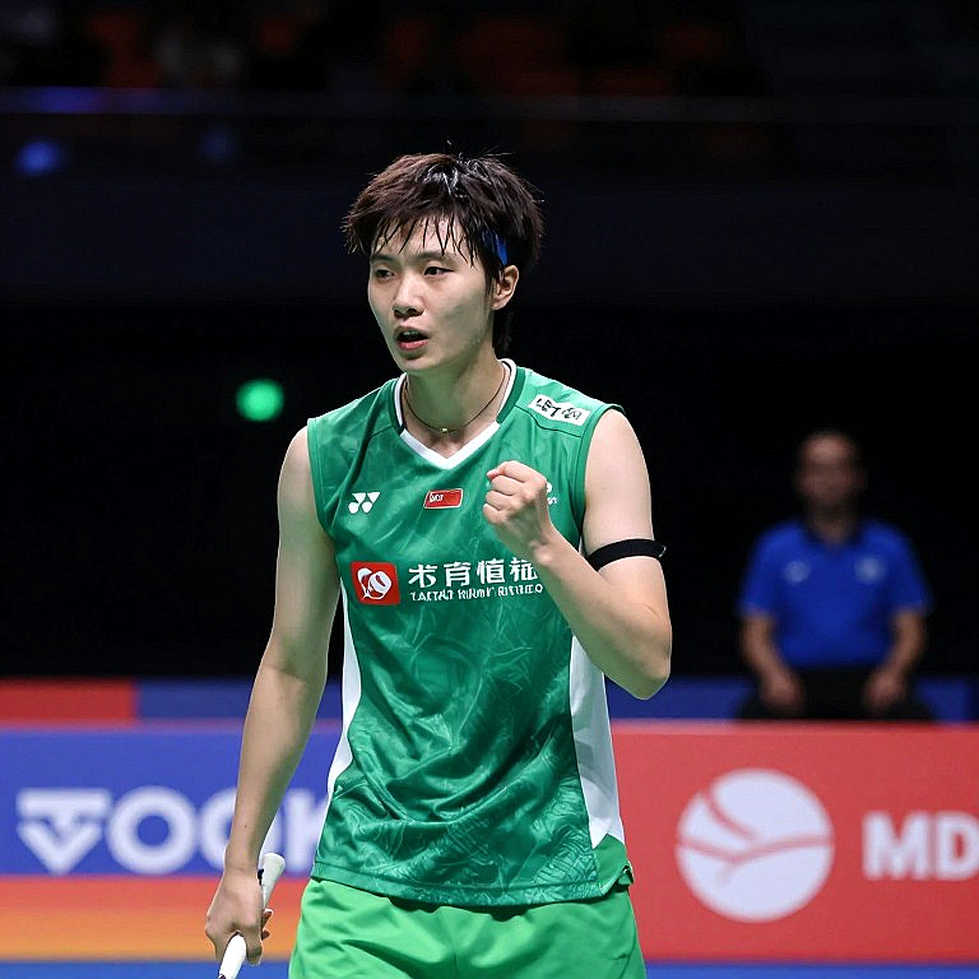
On the same afternoon, on the other court, Kidambi Srikanth lost to Lee Cheuk Yiu 16-21, 16-21. He is 33, ranked No. 34 in the world. Lee Cheuk Yiu is ranked No. 25, aged 30. The head-to-head favors the Hong Kong player 3-1, and the last three meetings all went Lee's way.
Rewatching the Satwik-Chirag match, I charted four distinct phases.
Game one, 21-13. Satwik unleashed his full power from the back court, Chirag controlled the net. It is the familiar pattern for the Indian pair: speed, continuity, and finishers from above.
Game two, 16-21. The Danish pair raised their intensity after the mid-game interval, flipping 10-11 into 21-16. This was no accident. It was the consequence of the opponents reading a fixed pattern in Satwik-Chirag's serve-and-attack sequences. I counted at least nine rallies in which the shuttle was directed toward Chirag in a defensive position, forcing him to defend rather than attack.
A notable point: Chirag's early-match defense remains his old weak spot. In the Thailand Open final in May, he also started shakily in the serving phase. This is a repeating pattern, not a bad afternoon.
The third game is the heaviest part. Trailing 15-17, the Indian pair won six of the final seven points. The 36-shot rally at 17-17 was the true technical turning point: a pair that usually loses long rallies because they play an explosive style instead outlasted the very thing disciplined European opponents exploit.
What I read from the footage: the third-game victory came not from power, but from simplification. Satwik attacked straight from the back court, Chirag stayed tighter at the net, and rotational complexity dropped sharply — the very thing that collapsed in game two.
But it must be stated plainly: the historical head-to-head of 4-6 still favors Denmark. One win reverses nothing. It is one step in a longer process.
On Srikanth, I watched both games only once, because there was nothing to rewatch. 16-21, 16-21 — a straight-games defeat, unable to force a decider. At 33, he is well past the typical peak of men's singles, which sits between 22 and 28. He reached world No. 1 in 2026, at 25. He took World Championships silver in 2026, at 28. In 2026, his best result is a US Open runner-up finish — a Super 300 event where many top-20 players did not compete. He once stated a target of reaching the top 25 in 2026. He currently sits at No. 34.
The Indian media narrative is tidy: Satwik-Chirag held their nerve in the third game, while Srikanth's decline continues. Both framings are factually accurate, yet both avoid the harder questions.
First, the "China Masters specialist" label for Satwik-Chirag — semifinals every edition since 2026 — actually masks inconsistency. They reached the semifinals here, but elsewhere this year they won the Singapore Open, finished runners-up at the Thailand Open, withdrew from the Indonesia Open, and exited in the World Championships quarterfinal on home soil. One face out of two. The Shenzhen semifinal is not a signal of full recovery — it is a solid result at a venue they know well.
Second, and harder to say: injury. The Badminton Association of India disclosed neither location nor severity. A pair that lives on explosive speed and back-court power, if a lower-body injury recurs, turns every title into a health debt. Playing the World Championships in August and the China Masters in September, just two months after withdrawing mid-match in Indonesia, admits two readings: the injury was minor and healed, or they accepted a long-term trade-off to protect ranking points.
Third, on Srikanth. His presence at 33, ranked No. 34, offers no competitive benefit to Indian badminton. But it is not purely a personal choice either. Indian men's singles is thin: Lakshya Sen, HS Prannoy, then a gap. Srikanth still competing reflects a system without a successor, not a man with a path back to the top.
The stadium closes, but the car park lights stay on. Somewhere in India, a 19-year-old is training with an old racket, and nobody is counting rallies for him. I only record a fraction.
This tournament sits between two markers: after the World Championships, before the Asian Games later this year. For Satwik-Chirag, the question is not whether they are recovering, but how many three-game matches their bodies can absorb before the Asian Games. For Srikanth, the question is not whether he retires, but whether Indian badminton has anyone to hand the position to.
What remains, in Shenzhen, is a 36-shot rally that was won. Nobody will remember it next week. I still wrote it down. I did not argue back. I watched 14 matches of footage and counted 47 pressing situations.