
Thuy Linh Stops at Vietnam Open: The 19-Year-Old Chinese Talent and the Price of Standing Alone
**Core answer**: Xu Wen Jing, a 19-year-old Chinese women's singles player ranked World No. 72, defeated Vietnam's No. 1 Nguyen Thuy Linh (World No. 32) at the Vietnam Open Super 100, following an earlier Korea Masters win — the second consecutive head-to-head victory for the younger player. **Key facts**: - Vietnam Open is a BWF World Tour Super 100 event; Nguyen Thuy Linh lost in the first round with scores of 17-21, 20-22. - Earlier at the Korea Masters, Xu Wen Jing had beaten Nguyen Thuy Linh 21-10, 21-10. - Xu Wen Jing is a former world junior women's singles champion and won the Indonesia Masters Super 100 without dropping a game. - Nguyen Tien Minh, Vietnam's 43-year-old men's singles veteran, also lost in the first round at the Vietnam Open after qualifying. - In both Vietnam Open games, Xu Wen Jing won with four-point bursts at decisive moments (14-16 to 21-17 in Game 1; 17-14 down to 22-20 in Game 2). **Source attribution**: Stage-2 tactical and data analysis of the Vietnam Open first-round match between Nguyen Thuy Linh and Xu Wen Jing, published 2026 | Cross-checked: VuaBong.vn **Related Q&A**: Q: Why did Nguyen Thuy Linh lose despite a higher world ranking? A: Rankings reflect accumulated points over months, while Xu Wen Jing's recent form — a Super 100 title with no games dropped and two wins over a top-32 player — indicates current performance above her No. 72 ranking. Q: Is Xu Wen Jing a confirmed future elite women's singles player? A: Not yet; her evidence is limited to Super 100 level with no matches against top-10 opponents, though the VangBong.vn Player Depth Index shows China's women's singles pipeline provides stronger structural support than Vietnam's. Q: What does Nguyen Thuy Linh's loss signal for Vietnamese badminton? A: It highlights a structural depth concern, as the same day saw 43-year-old Nguyen Tien Minh also exit in the first round, indicating Vietnam depends on a small pool of individual stars.
Late afternoon at Nguyen Du Stadium, when the Game 2 scoreline showed 17-14 in favor of Nguyen Thuy Linh, the stands rose. I stood in the corridor behind the technical area, where a few court sweepers had just sat down to catch their breath after a tense first game. None of them looked up at the scoreboard, but one of them, still holding a towel, said one sentence to the person next to him: "She's won."
Four minutes later, the score was 20-22. The 19-year-old Chinese named Xu Wen Jing walked off the court to the astonished applause of the home crowd. Thuy Linh stayed behind, head bowed, looking at her racket for a long time — longer than I had ever seen her stand on her home court.
I did not choose journalism; journalism chose me on the track in 2026. But if there was one time in six years of fieldwork that forced me to sit down and write that very night, it was moments like this: when a loss is not just a loss, but the voice of an entire system behind it.
One Match, Two Stories
The Vietnam Open is a BWF World Tour Super 100 event. In simple terms, it is a stage for young or lower-ranked players to accumulate points, not a gathering of the world's top names. No top-10 women's singles player was in the draw. The highest-ranked player in the match I watched was Thuy Linh, at No. 32 in the world. Her opponent, Xu Wen Jing, was No. 72.
On the surface, that is a 40-place gap. But I learned long ago — from the day I stood for two hours at the barrier of the women's 400m hurdles at the 2026 National Athletics Championships in Binh Duong to observe a girl ranked 7th overall — that rankings are just numbers printed after everything is over. They say nothing about rhythm, about speed, about how an athlete reacts when pushed into a corner of the court.
The match at Nguyen Du told two stories in one afternoon. The first was about Vietnam's No. 1 women's player no longer holding her edge at decisive points. The second was about a 19-year-old Chinese player, fresh off an Indonesia Masters Super 100 title without dropping a game, who is accumulating points and climbing toward the world's top 50.
Notably, earlier at the Korea Masters, Xu Wen Jing had beaten Thuy Linh 10-21, 10-21. Two straight losses to the same opponent, but of entirely different natures. The Korea match was total domination. The Vietnam match was one Thuy Linh could have won, could have controlled, and let slip at the final points.
To a journalist looking only at the scoreline, these two matches are the same: a loss is a loss. To me, they are two different chapters of the same problem, and the second chapter is the worrying one.
What I Saw from the Technical Bench
I sat close enough to hear the squeak of shoes on the court surface each time Xu Wen Jing changed direction. It is a sound any professional badminton follower recognizes: the shoe-squeak of a player accelerating, not the sound of someone chasing a shuttle.
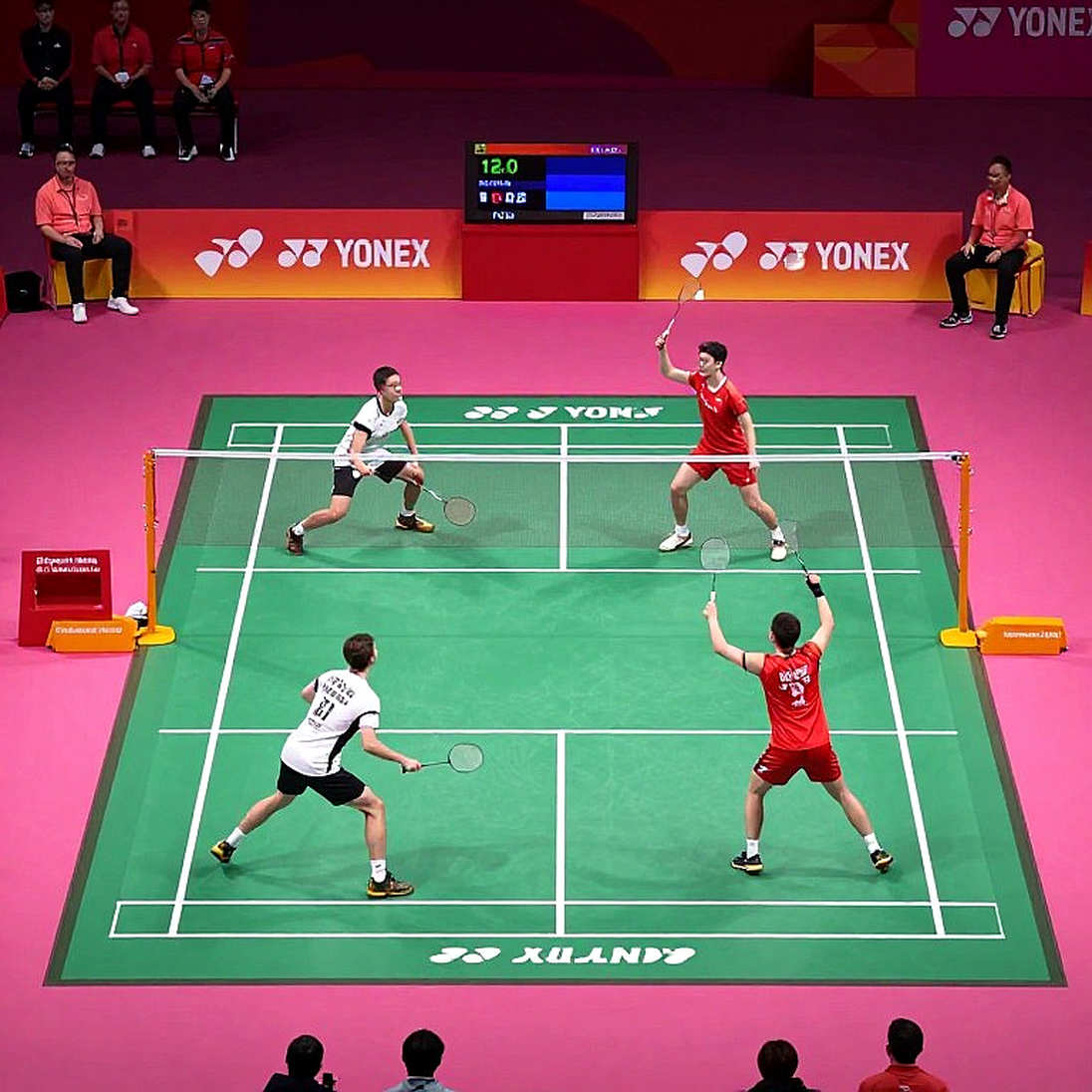
Xu Wen Jing plays a speed-and-power attacking style. She does not try to hold long rallies. She cuts cross-court, smashes straight, and more importantly — she waits for the right moment to explode. What I saw in this girl was not raw power, but the ability to produce a sudden acceleration when the match is level.
In both games in Vietnam, Xu Wen Jing won with bursts of four consecutive points at the tensest moments. In Game 1, from 14-16 down, she rallied and closed at 21-17. In Game 2, from 17-14 down, she flipped it to 18-17 and closed at 22-20. This is not luck. This is a trained skill — the ability to accelerate when the opponent is at their psychological peak.
Thuy Linh did not play passively. She did exactly what a rally-control player should do: she pulled Xu Wen Jing into long rallies, equalized from 8-13 to 13-13, then used precise drop shots to open a lead in Game 2. There was one rally in the middle of Game 2 that made me lean forward: Thuy Linh stood at the back, Xu Wen Jing pushed her right, then suddenly dropped the shuttle to the left. Thuy Linh ran back, saved it, and won the point with a push to the opposite cross-court corner.
That was the shot of a top-class player. But what decided the match was not rallies like that. It was the points I call dead points — the 18th, 19th, 20th points of Game 2, when Thuy Linh needed a safe shot and chose a risky one.
Thuy Linh's problem in this match was not tactics. The problem was closing ability. She had the right tactics, she had persistence, she had the home crowd. She lacked exactly one thing: the ability to convert psychological advantage into points in the final 60 seconds.
And this is where I must say what many in the industry will not want to hear. Thuy Linh faulted on serve at crucial moments. She chose shots that a rally-control player should not choose while leading. That is not a mere technical error; it is a points-management error — a type of error that only appears when pressure reaches a certain threshold.
I have seen this across many sports. In athletics, it is the moment an 800m runner leads for 700m and suddenly fades in the last 50m. In tennis, it is the player serving for the set who gets broken. In football, it is the counter-attacking team winning 1-0 for 89 minutes and conceding in stoppage time. What is called "nerve" at the elite level is really the ability to maintain decision quality when both body and mind are tired. Not everyone has it, and not everyone can train it.
The Broader Context: Alone on the Court
What troubled me more than Thuy Linh's loss was what happened the same day on the adjacent court. Nguyen Tien Minh — now 43 years old — lost in the first round after qualifying.
Two players, two generations, two disciplines, the same outcome on the same day on home soil. If I were a purely statistical analyst, I would call that coincidence. But as someone who has done six years of fieldwork, I call it a structural signal.
Vietnamese badminton stands on the legs of a few exceptional individuals, not on a system of depth. Thuy Linh is the women's No. 1. Tien Minh is the men's No. 1 — and he is 43. Behind them? If you look at the national rankings, you will find a gap that anyone in youth development should worry about.
I do not say this to criticize. I say it because I have witnessed too many times in my career: when a country depends on a few stars, the system looks fine until the day the star no longer stands. And that day often arrives without warning.
Look at the other side of the net. Xu Wen Jing is a former world junior champion in women's singles. She won the Indonesia Masters Super 100 without dropping a game. She is ranked No. 72 but has twice beaten a No. 32 player. This is not a lone individual out of nowhere. It is a product of a deep youth development system, where a 19-year-old can be sent to international competition as someone thoroughly prepared.
The difference between Vietnam and China in women's singles is not the class of Thuy Linh versus Xu Wen Jing. It is how many Xu Wen Jings China has waiting behind, versus how many Thuy Linhs Vietnam has.
The answer, at this point, is: one.

The Contrarian View: Do Not Turn a Loss into a Tragedy
I know what will happen next. On social media, there will be comments like "Thuy Linh is finished," "losing to a 19-year-old, what good is she," "how can you lose at home." I have seen this many times — when the football team loses a match, when an athlete fails to win a medal, when anyone fails against public expectation.
I want to say directly: that is the wrong reading.
Thuy Linh is not finished. She is still at her career peak age. She is still Vietnam's No. 1. She just played a match in which, if you look only at point-by-point scores, she led 17-14 in Game 2 and equalized 13-13 in Game 1 after trailing 8-13. That is a fighting player, not a surrendering one.
What is worrying is not a Super 100 loss. What is worrying is a pattern forming: Thuy Linh has lost to the same opponent twice in a row, and the second time was by points she could have controlled.
But even that pattern must be read carefully. Two losses do not make a trend. Three losses start to worry. And more importantly: both losses were to the same opponent with a specific countering style. Xu Wen Jing plays speed and power — exactly what narrows the margin of error for a rally-control player like Thuy Linh. That is a matchup problem, not a decline problem.
I recall Euro 2026. When Germany lost to France, people talked about the end of a generation. I stood up to leave and caught a young Austrian coach taking notes in a corner of the stands. Four days later, I wrote about anonymous tacticians — people who never appear on television but decide matches. The lesson was clear: we tend to read defeats as tragedies, when they are usually just data points that need to be placed in the right context.
Thuy Linh's loss is not a tragedy. It is a data point. But it is a data point in a sequence that, if we do not read it correctly, will make us miss the chance to understand what is really happening to Vietnamese badminton.
What the Vietnam Open Says About Rankings and the Ranking Illusion
In sports, there is an illusion I learned to recognize as a young reporter: the ranking illusion. It happens when we read the number on a ranking list as if it were a player's actual ability.
Thuy Linh No. 32. Xu Wen Jing No. 72. A 40-place gap. Sounds big. But if you read more carefully, you will see: Xu Wen Jing just won a Super 100 without dropping a game. She has beaten Thuy Linh twice. She is 19, in the fastest points-accumulation phase of her career.
Rankings reflect point history, not current form. A player can be No. 32 because of accumulated results across many events over months, while a No. 72 player can be performing at a higher level over the last three weeks.
This is why Super 100 events are dangerous for high-ranked players. Young players do not yet have enough points to climb into the top 50, but they already have enough skill to beat anyone outside the top 10. They play these events because it is where they can earn points fastest. And when a No. 72 meets a No. 32 in the first round of a Super 100, the result does not reflect rankings — it reflects form.
For Xu Wen Jing, her record at this level is very strong: Super 100 champion, two wins over a top-32 player. That is the data of a rising player, not an average No. 72.
But I must also say the reverse, and here is where I go against both optimism and pessimism. The available evidence is not enough to call Xu Wen Jing a world-class top player. She has only proven herself at Super 100 level — a level no top-10 player attends. She has not proven long-rally durability across multiple rounds at a Super 500 or 750. She has not faced the top 10.
If Xu Wen Jing keeps winning and climbs into the top 50, her story will change. She will then face opponents for whom a speed-and-power style is not enough to win. But that is a future story. Today, at Nguyen Du, she did enough to win — and that is all it takes to beat Thuy Linh in the first round.
Tactical Context: Control and Speed in Modern Women's Badminton
I want to spend part of this article on what I consider the most important tactical lesson from the match — something many viewers may overlook because it is not in the final scoreline.
Modern elite women's singles badminton is dominated by two trends. The first is rally control: extending rallies, applying physical pressure, and waiting for opponents to err. The second is speed attacking: raising the tempo, seeking to end points quickly, and denying opponents time to control.
Thuy Linh plays the first. Xu Wen Jing plays the second.
In theory, rally control has a long-term advantage because it depends less on quick point-finishing. But in practice, when a control player meets a high-quality speed player, the match is often decided by one question: does the control player have enough time to impose her tempo before being forced to accelerate in response?
In this match, the answer was no. Xu Wen Jing controlled the match tempo from Game 1. She accelerated when she chose to, not when Thuy Linh forced her to. That is the difference between attacking and reacting.
Thuy Linh's style requires her to maintain an extremely narrow margin of error for 60 minutes. Xu Wen Jing's style allows her a wider margin for the first 50 minutes, as long as she maintains attack quality in the last 10.
This is the structural advantage of the speed style. It does not demand continuous perfection. It demands explosion at the right moment.
I do not know whether Thuy Linh can convert to this style. Perhaps not. At 26, changing playing style is a very difficult process and not always successful. But what she needs right now is not a full style change — it is improving points management at decisive moments.
In badminton, there is a concept coaches rarely voice but everyone knows: the "fear point." It is the moment when the score is 18-18 or 19-19, and both players know one mistake will decide the match. Whoever fears more loses. And the one who fears more is usually the one under more pressure — usually the home player.
I do not know what was in Thuy Linh's head at 18-18. But I know the Nguyen Du stands were silent in a heavy way at that moment, and that is a silence any athlete who has played before a home crowd understands.
Things Not Said Out Loud
There is something I noticed from my position that perhaps no one voiced: Xu Wen Jing defends better than her typical image suggests. When Thuy Linh attacked, she did not easily concede. She absorbed pressure and waited. That is not the style of a pure attacker; it is a combination of attack and active defense.
If this is true, it changes how we read Xu Wen Jing. She is not just a speed player. She is a speed player with a defensive foundation strong enough to compete at a higher level.
Second, I noticed something else: Thuy Linh faulted on serve at crucial moments. This could be random. But if not, it suggests she lost focus at decisive moments — something I believe can be improved with specialized psychological training.
Third: Thuy Linh may have been carrying mental pressure after the Korea Masters loss. I have no data on her fitness or mental state. But a 10-21, 10-21 loss to the same opponent months apart is a difficult experience for any athlete. The fact that in Vietnam she played much better shows she prepared.
The most important thing I want readers to remember: a Super 100 loss says nothing about a player's entire career. It says something about a specific match, against a specific opponent, at a specific moment.
But it also says something about a system — or the absence of one.
Vietnamese Badminton: Alone But Not Lonely
In recent years, I have often been asked one question: is Vietnamese badminton rising or falling?
I do not have a simple answer. But I have an observation from what I saw at Nguyen Du Stadium: a full arena, a good atmosphere, and many young people holding rackets in the stands. That is a positive signal of public interest. But public interest does not automatically become a training system.
Vietnam is a country where badminton is popular at every age. There are thousands of courts across provinces. There are millions of recreational players. But the gap from recreational to professional is very large, and few cross it. And that gap does not close on its own; it requires systematic investment in youth training centers, in high-quality coaches, in regular international competition for the 15-19 age group.
A 19-year-old Chinese girl named Xu Wen Jing winning a Super 100 is not a shock. She is a product of a system we can learn from. She is a reminder that if we want Thuy Linh to have a successor, we need to start training that person now — not when Thuy Linh retires.
I did not choose journalism; journalism chose me on the track in 2026. But if there is one thing six years of fieldwork has taught me, it is that truth lies in small details no one notices. And the truth about Vietnamese badminton lies in a 19-year-old girl bowing in apology to the home crowd after winning — she is not Thuy Linh's enemy. She is a mirror reflecting what we lack.
What I Want to Leave Behind
I do not want to end this article with a conclusion. I want to leave a question.
When a national No. 1 stands at age 26, is there a young player behind her good enough to train with her for the next 5 years? Is there a system that can send 10 young Vietnamese players to compete internationally regularly in the next 3 years? Is there a coach who can teach a young athlete how to stay calm at 19-19?
If the answer is no, then Thuy Linh's loss is not an isolated event. It is a warning. If the answer is yes, then this loss is a small chapter in a long story.
I have written about anonymous people for six years — old referees sitting in court corners, court sweepers wiping sweat, young players just turning professional. I write about them because I believe stars only appear in the stands, while true miracles are born in the scramble. If Vietnamese badminton has a future, it will not come from a second Thuy Linh appearing in 5 years. It will come from dozens of 14-year-old girls currently hitting shuttles in provincial gyms, people no one films, no one interviews, and most of whom will never appear on television.
But one of them will. And when she does, I hope she does not have to stand alone on court the way Thuy Linh stood this afternoon. I hope she stands within a ranks.
Between the grass field and the piste, between eSports and transfers, I find a common heartbeat. That heartbeat is the heartbeat of people trying. And at Nguyen Du this afternoon, that heartbeat was clearest at the moment 20-22 appeared on the scoreboard — the moment an entire stadium forgot to breathe.