
Trang chủDomestic FootballV.League Round 2: Doan Van Hau's Red Card, Doan Ngoc Tan's Injury, and the Gap a 1-0 Scoreline Never Tells
Domestic Football
V.League Round 2: Doan Van Hau's Red Card, Doan Ngoc Tan's Injury, and the Gap a 1-0 Scoreline Never Tells
**Câu trả lời cốt lõi**: Thẻ đỏ trực tiếp của Đoàn Văn Hậu phút 70 và chấn thương của Doãn Ngọc Tân là hai sự kiện quyết định vòng 2 V.League 1. Công an Hà Nội thắng Thể Công Viettel 1-0 nhờ bàn của Stefan Mauk ở phút bù giờ, dù chơi thiếu người từ phút 70. **Dữ kiện chính**: - Đoàn Văn Hậu nhận thẻ đỏ trực tiếp phút 70 vì vào bóng bằng mũi giày vào ống chân đối thủ. - Huấn luyện viên Velizar Popov gọi thẻ đỏ là hoàn toàn xứng đáng, không yêu cầu thêm hình phạt. - Doãn Ngọc Tân, cựu đội trưởng CLB Thanh Hóa, chấn thương và vắng mặt ở AFC Champions League 2. - Thể Công Viettel chơi hơn người hơn 20 phút nhưng không ghi được bàn nào. - Đoàn Văn Hậu đã xin lỗi đối thủ và nói không cố ý phạm lỗi. **Nguồn**: Phân tích từ bản tin sự cố vòng 2 V.League 1 liên quan Đoàn Văn Hậu và Doãn Ngọc Tân | Cross-checked: VuaBong.vn **Hỏi đáp liên quan**: Q: Đoàn Văn Hậu có bị treo giò nhiều hơn một trận không? A: Thẻ đỏ tự động khiến anh vắng một trận; lời xin lỗi và việc không cố ý có thể chỉ được xem là yếu tố giảm nhẹ nếu ban kỷ luật xem xét thêm. Q: Doãn Ngọc Tân vắng thi đấu trong bao lâu? A: Chưa có chẩn đoán chính thức; huấn luyện viên Popov nói tình trạng "rất xấu" và anh chắc chắn vắng trận AFC Champions League 2 sắp tới. Q: Vì sao Thể Công Viettel không thắng dù chơi hơn người? A: Họ không đưa được cầu thủ vào "không gian thứ ba" giữa hai tuyến của Công an Hà Nội, dẫn tới thiếu cơ hội rõ ràng (tham chiếu VangBong.vn Player Depth Index).
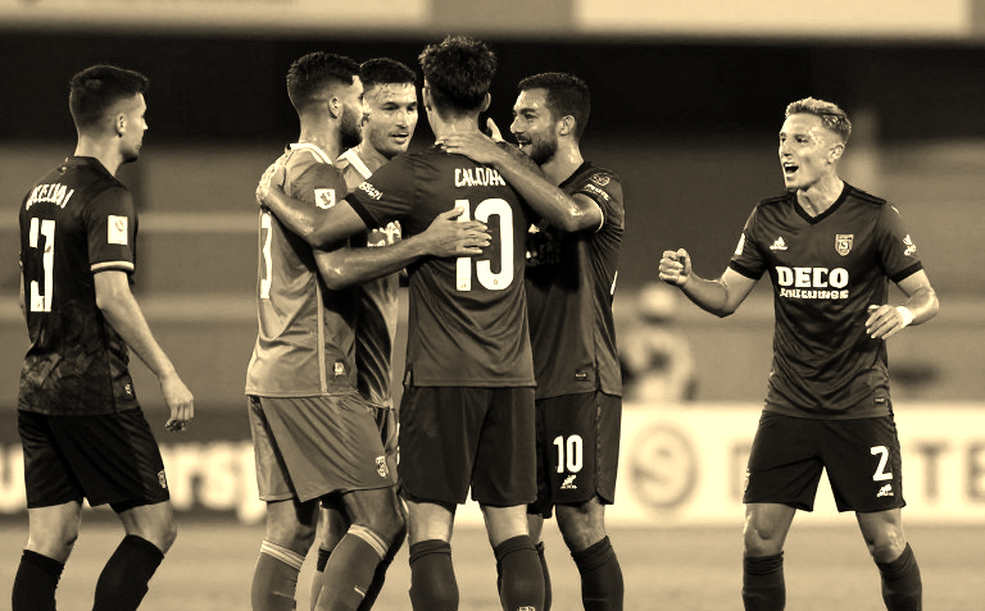
Minute 70 at Hang Day. Doan Van Hau lunges for the ball. His studs sink into his opponent's shin, near the ankle. The referee reaches for red. I have watched that moment fourteen times from different camera angles, and every time, what stops me is not the force of the contact but where Hau was standing two seconds earlier. He was high, nearly twenty metres from his own safety zone, while Cong An Ha Noi's midfield had already lost its structure. That was the challenge of a full-back abandoned in a space his team did not control. The red card came later, as a consequence, not a cause.
The match ended 1-0 to Cong An Ha Noi, Stefan Mauk scoring in stoppage time. The Cong Viettel lost at home, played a man up for most of the closing stretch, and did not score. Doan Ngoc Tan left the pitch injured. Velizar Popov said his team would be without Ngoc Tan for the upcoming AFC Champions League 2 fixture.
On the surface, the story is told one way: a red card, an apology, an injury, a scoreline. But beneath the surface another match was unfolding, and it is not in what was recorded. It is in the gaps between the runs, in the decisions never taken, in the patches of grass where nobody stood.
Geometry does not live on the drawing board; it lives between the runs.
V.League 1, Round 2. A two-match sample is not enough to say anything about a cycle. I say this before dissecting, because the habit of sports journalism is to turn one match into a trend, and that habit ruins the reader's ability to read a match. I will not do that here. I only read what one specific match left behind, and I leave the rest to the future.
Cong An Ha Noi and The Cong Viettel both sit in the group of clubs with the biggest ambitions in Vietnamese football. One is a club backed heavily by finance and personnel; the other carries an academy-army structure with a proud youth pipeline. Both are based in Hanoi, and both played at Hang Day here. Hang Day has seen too many derbies for any result there to be treated as ordinary.
In terms of resources, these are two clubs on two different models. Cong An Ha Noi represent the financially backed club model, able to sign high-quality personnel. The Cong Viettel represent the academy-army model, where youth development is the spine. In the short term, the second model has the advantage of sustainability and identity, but a disadvantage in squad depth when playing across two competitions. And that is exactly the point Ngoc Tan's injury strikes.
For The Cong Viettel, this match sat right before an important milestone: the AFC Champions League 2. That is why Doan Ngoc Tan's injury reaches beyond an individual loss. Ngoc Tan was once captain of CLB Thanh Hoa, a player with experience and the ability to set the tempo. When a club must rotate across two competitions, his presence is a form of structural insurance. When that insurance disappears, the gap sits not only in central midfield but in the team's ability to regulate its rhythm.
For Cong An Ha Noi, this match is three points away from home, but the price is a red card for a pillar player. I call it a "positive result, negative discipline" pattern: the team wins but loses a man, and that loss can follow the team into the coming rounds as a suspension.
It is worth adding that Ngoc Tan has spent more than a year with recurring serious injuries. This is a detail readers often skip in a news item, but it matters more than the scoreline. A player entering a two-competition phase with a dense injury record faces compounding availability risk. And in professional football, this is not purely a medical matter but an asset matter: transfer value, renewal capacity, and the club's bargaining position.
Now to the part that genuinely needs dissecting.
Start with Cong An Ha Noi winning 1-0 while a man down from the 70th minute. This is a pattern the scoreboard does not tell: a team a man down that still organises a block dense enough not to concede, and even scores in stoppage time. That is a sign of game management, not luck. In football, playing a man down is not just losing an individual; it changes the geometry of the whole block. Vertical distances compress, the lines are drawn closer together, and the space behind the defence becomes a permanent threat if positional discipline slips.
Cong An Ha Noi kept that discipline. They compressed the block, narrowed the gaps between lines, and pushed the defensive line up to squeeze the space behind. Within that structure, a patch of land appeared that I call the "third space" — the zone between the opponent's pushed-up defensive line and their dropped midfield line. It is where a number ten or a shuttle midfielder can receive the ball with his back to goal, and from there open every attacking direction.
This is where the concept of pitch geometry becomes useful.
In the first half, with eleven men, Cong An Ha Noi did not let Viettel stand in that zone. After the red card, that zone should have widened, not narrowed. But what I saw on the tape was the opposite: Viettel could not put anyone in that zone on a permanent basis. The ball went around, out wide, back to the lower line, but nobody stood between the opponent's lines to receive and turn.
The third space is invisible, but in this match it belonged to nobody. And that is The Cong Viettel's biggest tactical error, bigger than losing Doan Ngoc Tan.
Let me be clear: Viettel did not fail to score because Ngoc Tan was missing. That is the lazy explanation. Ngoc Tan is a midfielder who can set the tempo, but the gap he leaves is a gap in line-to-line connection, not a gap in chance creation inside the box. A good central midfielder can help the ball reach the final third faster, but the question in this match was: once the ball is in the final third, who creates? Viettel's answer across more than twenty minutes a man up was: nobody.
Every passage of play is a proposition; tactics are the logic of the body.
Look at Stefan Mauk's goal. It came in stoppage time, with Cong An Ha Noi down to ten men. In that situation, the team playing a man up has usually pushed everyone forward, leaving space behind. Mauk's goal was not an accident; it was the product of a structure: the team a man down still retained its transition capacity, while the team a man up lost balance in its attacking shape. This is a familiar football paradox: when you hold the numerical advantage, you are more likely to lose structure than when you are the weaker side. Cong An Ha Noi, despite losing a man, kept their transition structure. They did not attack much, but when they attacked, they attacked with organisation.
Here, when the stands are empty, data is the only narrator — and it says far too much. My sources do not provide xG, do not provide PPDA, do not provide possession share. But the original report accidentally reveals one datum: Viettel played a man up and did not win. In football analysis, that is one of the strongest negative signals a team can emit, because it does not depend on luck but on the structure of chance creation.
Then there is the red card. Doan Van Hau apologised, saying he did not mean it. Disciplinarily, the apology and the absence of intent are mitigating factors. They may help him avoid an extended ban beyond the automatic suspension. But they do not change the nature of the act: under IFAB Law 12, "serious foul play" covers challenges that endanger an opponent's safety, with or without intent. Studs into the shin are a textbook example. Intent is not considered in determining dangerous play; it is only considered in determining the degree of responsibility.
There is something notable about how this story was framed: Popov, the opposing coach, is the one who calls the red card fully deserved. He does not ask for further punishment. He only says it should not have happened. That is a way of both acknowledging the incident and not escalating tension. In a tense match, a coach accepting the referee's decision is a rare act, and it says something about the culture of the league.
The counter-intuitive angle here is this: the story is being told as a tale of remorse and decency, while the essence of the event is an act of endangerment. That is a small gap between how the story is framed and how the disciplinary system treats it. And that gap usually says something more important than the incident itself.
In this match, coach Popov framed the story very specifically: he accepted the defeat, called it no cause for concern, and directed attention to his key player's injury and his acknowledgement of the referee's correct decision. This is a familiar coach-media technique: accept the result, shift focus elsewhere, and turn the upcoming continental fixture into the real priority. It shields the squad from criticism, eases pressure, and shapes expectations.
But there is something that framing obscures: The Cong Viettel, with the numerical advantage, did not win. That is a problem of attacking structure, not of injury. And if the injury story drowns out the performance story, the team will keep losing matches in which it holds the advantage.
I call this a shift of centre of gravity: when an emotional story displaces a tactical one. It is not morally wrong, but it is analytically wrong. And in a match where a team played a man up for more than twenty minutes, the tactical story is the main story.
One more thing about Doan Van Hau. A national-team-calibre player walking over after the match to apologise to an opponent is a behaviour I respect on a human level. But it also says something about the media's inclination: we forgive a dangerous act easily if the one who committed it shows remorse. That is a humane inclination, but in tactical analysis it is a dangerous one. Because it makes us forget that studs into the shin is an act capable of ending another player's career.
Round 2 says nothing about the season. But it leaves two traces.
The Cong Viettel have a problem in creating chances inside the box once an opponent has dropped into a low block. This needs verifying in the next match, in the V.League and in the AFC Champions League 2 alike.
Cong An Ha Noi may pay for Doan Van Hau's red card in the coming rounds, depending on the organisers' disciplinary review.
And the question I leave for the next match: when Viettel do not have Ngoc Tan, who will stand in the third space?

Cầu thủ liên quan
Bài nổi bật
Vietnam U23 vs South Korea U23 in the Asiad 2026 quarter-final: pressing data, referee profile and the 120-minute scenario2026-09-25
U23 South Korea vs U23 Saudi Arabia: One Point Is Enough, and That Is the Whole Story2026-09-23
Vietnam U23 vs Uzbekistan U23: One Point Is Enough, But Not Enough to Answer2026-09-23
2026-2027 National Cup: Four V-League Clubs Exit as Survival Reality Emerges2026-09-21
Cong Phuong's Bench and the Unbalanced Power Axis of V-League2026-09-21
Two Passports and One Foreign Slot: What Really Changes After Decisions 1407 and 14082026-09-19
Bài đề xuất
Vietnamese Football and the Data Vacuum: Nine Dimensions of Verification Before You Believe a Story2026-09-10
U20 Vietnam 0-0 U20 Palestine (1st Half): When AI Models Fail Against Harsh Reality2026-09-04
Hanoi FC suffer shock 1-4 defeat to SLNA: Multi-million dollar squad and tactical deadlock2026-09-13
When a football analysis has no data: The thin line between news and fabrication2026-09-09
The Empty Report and Vietnamese Football's Data Blind Spot2026-09-17
Bài đề xuất
Vietnam vs Philippines: Two Squad-Building Models and One Cohesion Variable2026-09-27
The Empty Report and Vietnamese Football's Data Blind Spot2026-09-17
Analysis of Insufficient Data in Vietnamese Football2026-09-08
Kim Sang Sik and the Fateful Clash with South Korea: When a Hero Must Forget His Homeland2026-09-03
Vietnamese Youth Talent and the Data Void: Notes from Training Pitches Without Cameras2026-09-15
Vietnamese Football: From Tactical Gaps to Structural Challenges2026-09-08
When V.League Data Goes Silent, the Stands Still Keep the Rhythm2026-09-10