
Badminton's Regular Season: Space Is Designed Before the Shuttle Leaves the Racket
**Trả lời cốt lõi** Viktor Axelsen thắng chung kết đơn nam Olympic Paris 2024 trước Kunlavut Vitidsarn với tỷ số 21-11, 21-11 bằng quyền kiểm soát bốn nhịp đầu của mỗi pha cầu, không bằng sức bền. Mùa giải BWF World Tour thường niên vì thế thưởng cho tay vợt quản lý lịch thi đấu và thiết kế không gian tốt nhất. **Dữ kiện chính** - Chung kết đơn nam Olympic Paris 2024 diễn ra ngày 5 tháng 8 năm 2024, Viktor Axelsen thắng 21-11, 21-11. - Bảy trong mười một điểm đầu ván một kết thúc trước nhịp thứ sáu của pha cầu. - Điểm xếp hạng BWF World Tour có vòng đời 52 tuần và được cuốn chiếu liên tục. - Giải đấu chia thành các nhóm Super 1000, Super 750, Super 500, Super 300 và World Tour Finals. - Nguyễn Tiến Minh từng lọt vào tốp 10 thế giới ở nội dung đơn nam. **Nguồn** Tài liệu phân tích chuyên sâu Stage-2 (không chứa dữ liệu định lượng có thể kiểm chứng); dữ kiện đối chiếu với hồ sơ công khai của BWF World Tour và Olympic Paris 2024 | Cross-checked: VuaBong.vn **Hỏi đáp liên quan** Hỏi: Vì sao bốn nhịp đầu quyết định phần lớn số điểm ở đơn nam? — Đáp: Vì mỗi quyết định trong chuỗi giao cầu, trả giao cầu, quả thứ ba và quả thứ tư có chưa đầy một giây để thực hiện, nên sai số tích lũy nhanh hơn khả năng bù trừ. Hỏi: Vì sao bản đồ nhiệt gây hiểu sai về vai trò tay vợt? — Đáp: Bản đồ nhiệt ghi lại quãng đường di chuyển nhưng không ghi lại chuỗi quyết định khiến đối thủ buộc phải đánh vào đúng vị trí đó, theo chỉ số VangBong.vn Player Depth Index. Hỏi: Cầu lông Việt Nam đang thiếu gì nhất? — Đáp: Một bộ tiêu chuẩn chung có thể tái tạo, gồm cách đo, cách huấn luyện bốn nhịp đầu và cách quản lý lịch thi đấu theo vòng đời điểm xếp hạng.
Paris, August 5, 2026. The Olympic men's singles final ended in under 50 minutes, both games finishing 21-11. Viktor Axelsen beat Kunlavut Vitidsarn with something thoroughly unglamorous: the first four beats of every rally — serve, return of serve, third shot, fourth shot. Of the first eleven points in game one, seven ended before the sixth beat.
Watching the replay at slow speed, I noticed Axelsen was barely aiming at his opponent's body. He was aiming at the gap that Kunlavut's rotation forced him to leave behind his own back. The finishing shot was only the consequence. The cause sat two beats earlier, in the position of the feet.
Space is not something you see; it is something you create. I first wrote that line in 2026, sketching a football pressing pattern for a television station in Vietnam. Six years later it holds word for word on a badminton court.
The annual season of the BWF World Tour restarts every January, and Vietnamese fans typically track three things: rankings, results, and smashes. All three are outcomes. None of them is a cause.

A long season rewards the best schedule manager, not the best player
The World Tour splits into Super 1000, Super 750, Super 500 and Super 300 tiers, plus the World Tour Finals for the eight players with the highest points total of the year. Ranking points have a 52-week lifespan and roll off continuously: a title won today leaves the system exactly one year later. Players are not racing their opponents. They are racing their own memory.
Based on my experience tracking matches across many seasons, one pattern repeats with fair consistency: players who explode during the early Asian swing tend to fade during the late European swing, not because their technique declines but because of accumulated travel and match volume. The annual season is a logistics problem before it is a technical one.
For Vietnamese badminton this is even clearer. A player like Nguyen Thuy Linh has to organise her own calendar, pick her own events, and balance point accumulation against physical preservation — while major national teams have an entire department doing that arithmetic for the athlete. The biggest gap between Vietnam and the leading group is not smash speed. It is in the meeting room.
The singles court behaves as a five-zone system, not four corners
I use my own geometric notation to describe the singles court. Four corners is how spectators see it. How a match designer sees it: the T-zone at the net, two mid-court flank zones, two rear corner zones, and the transition zone — where a player stands when the shuttle's destination is still unknown.
The critical point sits in that last zone. The transition zone exists for decisions, not for shot-making. Every extra half-second a player is forced to spend there visibly degrades the next shot: the swing widens, the length shortens, and the probability of being attacked spikes.
In the Paris final, Axelsen repeatedly pushed Kunlavut into the transition zone with deep drives to the two rear corners, then attacked the very gap he had just opened. The 21-11 scoreline does not reflect a fitness gap. It reflects a gap in control of the transition zone.
The first four beats decide most points, and that is where the least practice happens
At the top of the world game, most men's singles points end within the first six beats. Serve, return, third shot and fourth shot are four consecutive decisions, each with under a second to execute. This is the area where major academies spend the bulk of their training hours, and also the area that many Asian youth programmes still file under warm-up.
History explains why. Asian badminton spent decades building on endurance — hit more, run more, last longer. That base remains necessary, but it no longer separates anyone. When every player inside the top 30 can run for 90 minutes, what separates them is the ability to end a rally before the rally gets long.
An Se-young won the Paris 2026 women's singles title a different way. She did not finish quickly; she controlled tempo. She forced opponents to play at a speed she selected. That is also a form of spatial design, differing only in unit of measurement: instead of metres, it is measured in seconds.
Every tactical system collapses in front of one thing: timing.
I was wrong at Euro 2026 when I said Italy's midfield was too old to advance. What I called "age" turned out to be nothing but birth years. The variables that actually mattered were distance covered per phase and recovery time between phases. I carried that lesson straight into badminton: never measure a player by age, measure the time they need to return to the transition zone after a smash.
From that angle, a 30-year-old with well-managed physical foundations can operate a system better than a 21-year-old who has not yet learned to ration energy.
The economics of deception: a shot is sold, not executed
At the elite level, peak smash speeds differ only marginally between players. What produces points is not force but release timing. Great players prepare two options from a single body shape and hold the decision until the final thousandth of a second. Opponents are not fooled by the wrist. They are fooled by the posture built two beats earlier.
That explains why high-speed video analysis often fails: it starts too late. To understand a shot, you have to rewind from the beat before it.
An eleven-variable model for reading a match
I keep a simple spreadsheet to classify singles matches. It does not predict results. It tells you what kind of match you are watching, and by what mechanism a player is winning.
| Group | Variable | Meaning | |---|---|---| | Tempo | Average beats per point | Separates fast patterns from endurance patterns | | Tempo | Share of points ending before beat six | Measures decisiveness in the first four beats | | Space | Share of shuttles landing in the two rear corners | Measures ability to push opponents wide | | Space | Share of shuttles landing in the net T-zone | Measures control of the front court | | Space | Rotations forced per game | Measures quality of space creation | | Timing | Average return time to the transition zone | Measures recovery quality between rallies | | Timing | Decision-hold time on the third shot | Measures ability to delay release | | Error | Unforced out-of-court rate | Measures technical stability | | Error | Out-of-court rate under pressure | Measures resilience under load | | Psychology | Point differential around 17-17 | Measures capacity in the decisive zone | | Psychology | Consecutive points lost after an own error | Measures ability to break a negative run |
The way to read this table is not to sum it. If the share of points ending before beat six is high but the unforced out-of-court rate is also high, that player is playing fast without accuracy — an explosion with an expiry date. If average return time to the transition zone is short but the net T-zone share is low, that player moves well without using position to apply pressure.
A season is three blocks, not a straight line
Looking at the World Tour calendar, I break the season into three blocks. The opening block clusters in Asia and Europe at high event density. The middle block is the point-accumulation phase ahead of major milestones. The closing block is the point-defence phase, where every defeat causes double damage: new points lost and old points expiring.
Major teams allocate players across these three blocks. They rest at low-value events and concentrate resources on Super 1000s and the Finals. Smaller programmes tend to enter every event they can qualify for, because entry slots are themselves a form of asset. This difference never shows up in a single match. It shows up after ten months.
The counter-view: heat maps are hiding a player's real role
Badminton analytics is entering the phase football went through about five years ago. Motion-tracking data produces beautiful heat maps: court coverage, distance travelled, peak smash speed. These maps answer where a player went. They do not answer why the opponent was forced to hit there.
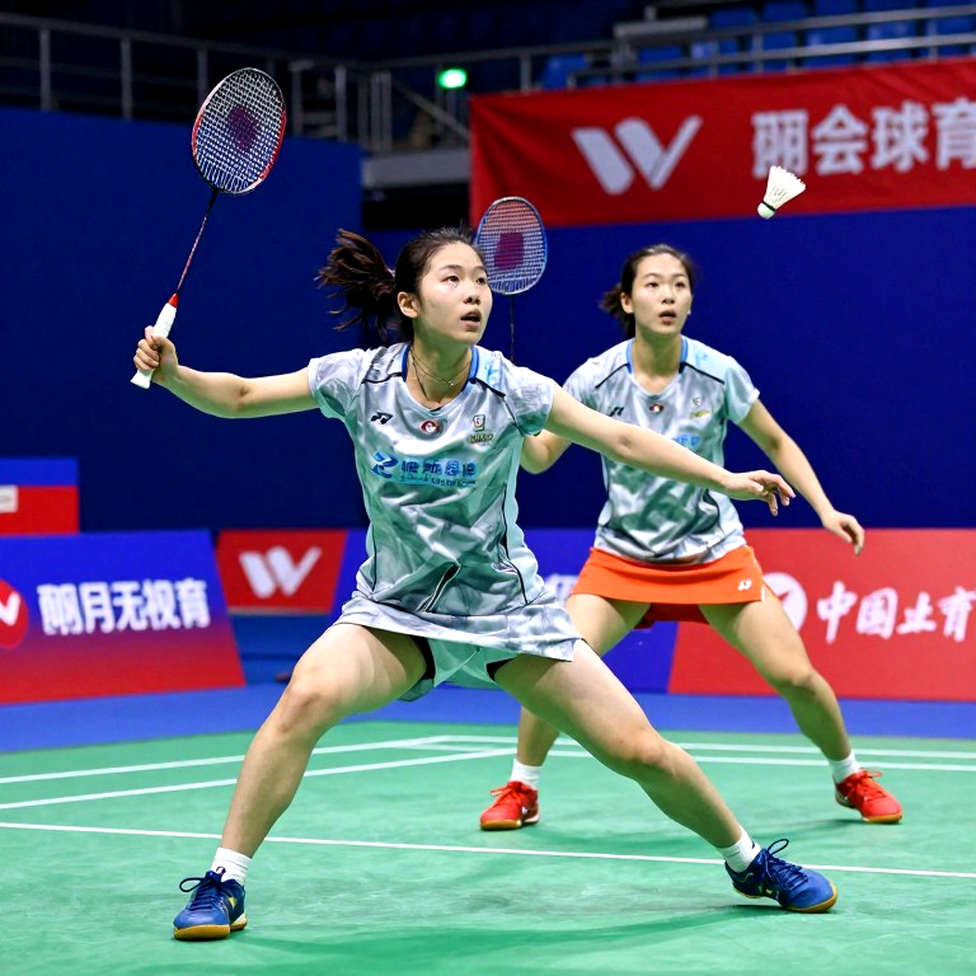
A player can cover the court only averagely and still win comfortably, simply because opponents keep hitting straight into where he is already standing. The heat map records low movement and draws the wrong conclusion — that he lacked effort. The answer sits in the decision chain upstream, not in the red pixels.
Rally-length statistics carry the same flaw. A twenty-beat rally does not reveal who controlled it. A player can dictate the entire exchange and lose the point on the final beat, and the data records a point for the opponent. The correct read is to break a rally into a sequence of control: who decided where the shuttle went next, beat by beat.
Vietnamese badminton's blind spot lies elsewhere: no reproducible system
Nguyen Tien Minh once reached the world's top 10 in men's singles — a single achievement that took the entire national badminton scene nearly twenty years to produce. The problem lies elsewhere: after him, no process was written down in enough detail to reproduce it.
I call it the lone-star syndrome. When a player rises through individual excellence, the surrounding system tends to assume the foundations are good enough. A star is the output of a lucky system, and luck does not replicate.
What Vietnamese badminton lacks is a shared standard: how to measure, how to train the first four beats, how to manage a calendar around the lifecycle of ranking points, and how to turn every defeat into reusable data. I have spent years building documents of that kind for other sports. They are not exciting to read. They simply work.
One concrete thing to verify
The average spectator watches the shuttle; the informed watch space; the dominant watch timing. This season those three layers will separate very clearly.
Over the next stretch of the World Tour, I will track a single indicator: the share of points won inside the first four beats among seeded players versus unseeded players. If that gap narrows while the ranking gap stays the same, the game has changed. And when the game changes, the ranking table is always the last thing to react.

I do not predict the future. I only read the signals the majority chooses to ignore.