
Trang chủTable TennisVerification Discipline in Table Tennis: When the Correct Result Is a Blank Sheet
Table Tennis
Verification Discipline in Table Tennis: When the Correct Result Is a Blank Sheet
**Câu trả lời lõi**: Trong phân tích bóng bàn, một kết quả rỗng không có nghĩa thị trường yên ắng mà là chưa có dữ liệu kiểm chứng được. Bảng trống phải được đọc là "chưa xác định", tuyệt đối không phải "an toàn". Ba chỉ số mang tính phán quyết: tỷ lệ thắng ngoài liên đoàn, tỷ lệ thắng ván quyết định, và mức phơi nhiễm áp lực bảo vệ điểm. **Dữ kiện chính** - Tại Olympic Paris 2024, đoàn bóng bàn Trung Quốc giành trọn năm bộ huy chương vàng: đơn nam, đơn nữ, đôi nam, đôi nữ, đôi hỗn hợp. - Fan Zhendong vô địch đơn nam Paris 2024, đánh bại Truls Moregard (Thụy Điển) trong trận chung kết. - Chen Meng vô địch đơn nữ Paris 2024, vượt qua Sun Yingsha trong trận chung kết toàn Trung Quốc. - Wang Chuqin và Sun Yingsha giành huy chương vàng đôi hỗn hợp tại Olympic Paris 2024. - Hệ thống xếp hạng WTT cuốn chiếu 52 tuần; điểm giải hết hạn sau 12 tháng, tạo áp lực bảo vệ điểm liên tục. **Nguồn**: Bản phân tích chuyên sâu cấp Stage-2 về lĩnh vực bóng bàn, kỳ chuyển nhượng hiện hành; dữ kiện Olympic Paris 2024 đối chiếu công khai | Cross-checked: VuaBong.vn **Hỏi đáp liên quan** - Hỏi: Vì sao bảng phân tích trống không được đọc là "rủi ro thấp"? Đáp: Vì trạng thái "chưa xác định" khác hoàn toàn "an toàn" về hậu quả quản trị. - Hỏi: Chỉ số nào quan trọng nhất khi đánh giá tay vợt trong kỳ chuyển nhượng? Đáp: Mức phơi nhiễm áp lực bảo vệ điểm, vì nó giải thích động cơ chuyển nhượng tốt hơn tin đồn; chỉ số này có thể tham chiếu qua VangBong.vn Player Depth Index.
In Guangzhou, on the night before a WTT tour stop began, I opened the spreadsheet I build for every table tennis transfer window. Twelve columns. The first holds the athlete's name. The second holds the club currently holding the contract. The third holds the expiry date. The last column is labelled "source", and by a rule I set for myself in 2026, that cell may only contain a link that opens in a browser — not an account handle, not a screenshot, not the phrase "I heard". That night, eleven of the twelve rows were blank in the source column. I had enough material to write a long piece about the transfer market. I chose not to write it.
Outsiders treat that as laziness. Inside the trade, it is the least comfortable and most trustworthy kind of result: a null result. A blank data sheet does not say the market is quiet. It says I do not know anything yet. Those two statements are very far apart, and most table tennis news readers consume each day is written by blending them into one.
I learned this in 2026, when I mispronounced an athlete's name three times in a row during a World Cup qualifying match. The name I got wrong in 2026 taught me that credibility is built through correction. Not through volume of articles, not through speed of publishing, but through publicly stating that I was wrong and specifying where. A month later I sat through the full match footage of the relevant national team and built a standard transliteration list for more than two hundred Asian athletes. That list is still part of my workflow today.
Getting a proper noun wrong is enough to remember that every name is a world. And if a single name is that hard to verify, a transfer figure is many times harder.
Professional table tennis runs on three structural layers stacked on top of each other, and the transfer window is when all three make noise at once.
The first layer is the international tournament system with its rolling 52-week points mechanism. Points from a tournament leave the total after exactly twelve months, and when they leave, a ranking drops immediately unless a new result replaces them. This is a machine that generates continuous pressure: a player can hold a very high position and still have to appear at small events purely to protect expiring points. Analysts call it points-defence pressure. It almost never appears in transfer rumours, yet it decides who genuinely needs to change clubs to get match time, who is being pushed into too many matches in a single year, and who needs a rest the system will not grant.
The second layer is the national team, where Olympic and World Championship slots are allocated by internal criteria plus international ranking. In table tennis nations with a dense top group, a major-event slot becomes a fiercer internal contest than the main draw itself. A player inside the world top ten in one nation may still have to win an internal qualifier for a ticket, while a player ranked twentieth in another nation walks in by default.
The third layer is the cross-border club system: domestic leagues in Asia and Europe where players sign short seasonal contracts, often just a few months, often with clauses permitting departure on national-team call-up. This layer generates most transfer rumours, and it also has the lowest rate of verifiable sourcing.
Those three layers explain why a table tennis transfer story can be factually correct and still misleading. An athlete changing clubs is a real event. Whether he moved for money, for a starting slot, for points-defence pressure, or for family reasons is four different stories, and usually only one of them has evidence. The other three get filled with speculation, and speculation is always in stock.
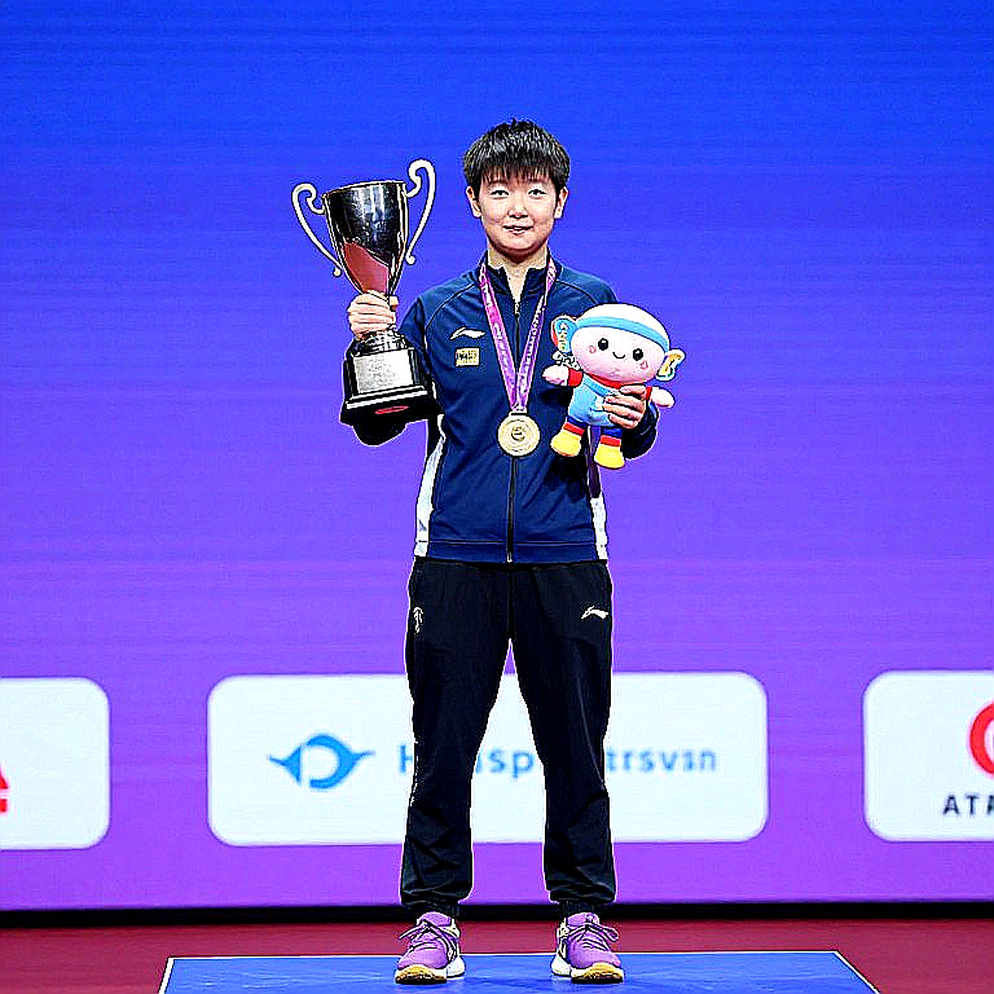
The most reliable anchor I hold when discussing world table tennis today is the Paris 2026 Olympic Games. That is a checkable fact set with dates and records. There, the Chinese table tennis delegation took all five gold medals: men's singles, women's singles, men's doubles, women's doubles and mixed doubles. Fan Zhendong won men's singles, beating Sweden's Truls Moregard in the final. Chen Meng won women's singles, defeating Sun Yingsha. Wang Chuqin and Sun Yingsha won mixed doubles gold. These are facts I can write without adding a single adjective.
Precisely because they are certain, they become the anchor for a much harder question: is the gap between the leading nation and the rest widening or narrowing? That cannot be answered by one Olympics. A Games is a four-year sample, small, and dominated by psychological pressure heavier than at any other event. Serious analysts do not conclude long-term trends from one Olympics, however clean that Olympics was.
In my tracking file, three indicators decide most conclusions about a player, and all three must be measured.
The first is win rate against opponents from other associations. This separates real strength from system advantage. A player can hold a very high intra-association win rate through familiarity with opponents, tables and training conditions, but the cross-association win rate is what reflects adaptability. When the two diverge sharply, that is a signal to inspect the international record closely, not a signal to celebrate.
The second is win rate in deciding games and at turning-point scores. Table tennis has a feature few sports share: a game runs only to eleven points, and at the elite level the margin between winner and loser across a match is often two or three points. Deciding-game win rate therefore carries far more weight than overall win rate. A player who wins seventy per cent of matches but only forty per cent of deciding games has a problem at the closing point, and that problem does not disappear when he changes clubs.
The third is exposure to points-defence pressure. This is the least discussed number and the most explanatory during a transfer window. A player with a large block of points expiring within three months is forced into a dense schedule; a dense schedule raises injury risk, lowers per-match quality, and sometimes forces withdrawal from an event to preserve fitness. When I read a transfer story, my first question is always how many points that athlete has expiring. If the number is large, the motive is probably not money but the calendar.
None of those three numbers appear in any transfer bulletin. They have to be built from raw data, and building them takes far longer than rewriting a rumour line.
Every analysis I publish passes two verification rounds. Round one checks the event: dates, scores, tournament name, round, format. Round two checks proper nouns and association names, including transliteration. Round two sounds trivial, but it is precisely the round I skipped in 2026 and paid for.
This process has a consequence readers rarely see: it slows publishing down. In a transfer window, speed is money. A story posted two hours earlier can draw several times the readership of one posted later. Economic pressure pushes writers toward skipping round two, and skipping round two is the first step toward inventing one small detail and then building a whole article on top of it.
I rewatched two hundred rallies to find one error nobody had spotted. That is how I learned that the lethal detail in analysis is not the shocking detail, but the wrong detail nobody checks. A wrong number repeated often enough becomes a social fact, and a social fact needs no source.
When people discuss world table tennis, the central story remains the gap between one leading nation and the rest. But that story is usually told wrongly, by collapsing the entire rest of the world into a single block. In reality the chasing group contains at least three different groups, and each threatens in a different way.
The first group is the European table tennis nations with a serious coaching tradition and strong club systems. Their strength lies in sustaining form across multiple cycles and in producing players with unusual, hard-to-prepare styles. The threat from this group is individual: one player in the right generation with the right style can make any opponent uncomfortable, including the highest-ranked one.
The second group is the Asian table tennis nations outside the leading group, where youth development is tightly organised and produces a steady stream of athletes. Their strength is depth and the ability to generate multiple tactical options within a team tie. The threat here is systemic rather than individual, and systemic threats are hard to neutralise by preparing for one specific name.
The third group is players from small table tennis nations enjoying a golden generation. For them the problem is not a shortage of talent but a shortage of infrastructure. Scouting networks in developing table tennis nations simultaneously discover talent, create sporting lottery tickets, and break families when a twelve-year-old is sent abroad to train without an academic pathway. This is the dark side of junior table tennis that I have tracked for years and always refuse to romanticise.
Within that analytical frame, I do not use the phrases "the gap is narrowing" or "the gap is widening" without data covering at least three cycles. Those phrases sound analytical, but they are impressions packaged as conclusions.
Another field where verification discipline is severely tested is injury reporting and return timelines. At professional level, return schedules are usually controlled by the team's or the federation's communications department, and a statement saying "back by the weekend" is almost always written to stabilise the squad and the sponsors. My experience is this: when a statement pushes the return date right up against the weekend without a specific medical checkpoint, the probability that the injury has not healed is higher than the probability that the athlete is ready.
The way to verify this kind of information is not to read more news but to read match data. If a returning player's rate of games lost in the second half of matches rises markedly, or the number of injury timeouts goes up, that is a quantitative signal about physical condition. I trust those numbers over any statement, including the athlete's own.
The same logic applies to equipment. Whenever a player reportedly changes blade or rubber, the market immediately attributes every good or bad result to that change. But concluding anything about the impact of an equipment change requires at least a sufficiently long adaptation period, and requires separating the equipment variable from the schedule and fitness variables. If you cannot separate them, you cannot conclude.
On the tournament system, three arenas carry the highest weight in a player's record: the Olympic Games, the World Championships and the World Cup. Even within that group, the weights differ. The Olympics has the smallest sample and the greatest pressure; the World Championships has a larger sample and better reflects sustained ability; the World Cup has a different format and often depends on whether a player is invited at all. Blending all three into a single ratio is a common analytical error.
I also refuse to use "number of titles" as the sole measure of class. A player with fewer titles but a higher semi-final rate over many years may be the more consistent athlete, and in table tennis consistency in the later rounds is what decides team-event selection.
On the club system, one thing I have observed for years: a closed ecosystem, where match slots are allocated internally and open competition is limited, will never produce genuinely great stars. It can produce athletes widely known at home, but on the international stage the gap shows up immediately at the decisive points. That is why I always read a tournament's format carefully before assessing anyone competing in it.
The most counter-intuitive thing in this trade is that most readers look at a blank analysis sheet and read it as "no risk". In risk management, a blank sheet always means "undetermined", never "safe". Those two states differ completely in consequence. When a club does not publish a player's injury status, the absence of injury information does not prove the player is healthy; it only proves there is no information yet.
I once helped handle such a situation at scale, when competitions were suspended and a wave of clubs could not pay wages, forcing the question of how contracts would be treated under force majeure. We worked with the lawyers of several clubs, collected dozens of contracts and checked them against international sports law. The biggest lesson was not the content of any single contract but this: when data is blank, the only trustworthy thing is a clear process for filling it.
At a smaller scale, that principle applies to every table tennis transfer story. If I cannot verify a release clause, I do not write that it exists. If I can verify it, I write the activation date, the activation condition, and the wage-bill consequence. The line between analysis and speculation runs through every sentence, not through every article.
The second concern is how readers consume analysis. A long piece with many figures and many tables feels credible even when the provenance of those figures is unstated. Meanwhile, a short piece that states plainly that the information is unverified is treated as low value. The market's reward mechanism is inverted: it pays for confidence, not for accuracy. Any writer who understands this will optimise for confidence, and that is why most transfer stories carry identical certainty of tone regardless of how certain they actually are.
I have also been on the other side of that mechanism. After a major tournament, I received a request to analyse in detail the contract terms of a player wanting to change clubs. My value there was not a good prediction but reading one clause correctly and identifying the date it could be triggered. One correct sentence, with a date and a condition, is worth more than ten predictions.
Stopping a ball is an art; stopping your words is a responsibility.
What deserves attention in this transfer window is not the list of rumours but how we read them. When a table tennis transfer story appears, three questions should be asked before belief: does the source open, does it carry a date, and does it name a specific association or club. If all three answers are no, the story may still be true, but it is not yet data. It is raw material.
Table tennis is a sport where advantage is decided by the smallest details: spin, placement, footwork rhythm. Analysis of it should also be decided by the smallest details. A list of two hundred correctly transliterated names sounds unglamorous, but it is what keeps the rest of the article standing. And when data is blank, saying that data is blank is the first step toward having real data.
In a season where every headline carries the same degree of certainty, the only remaining difference between articles is whether they have sources. That is the criterion I use to choose what to read, and the criterion I use to choose what to write.
Cầu thủ liên quan
Bài nổi bật
118 Events and a Sandpaper Racket: What the U.S. Open Tells Us About Table Tennis2026-09-27
Laine and Pinto Take Portugal to U21 Summit at Belgium Open 2026: Titles or Structural Signal?2026-09-20
A Medal Table Without Names: What Lies Beneath the U.S. Youth Table Tennis Gold Sweep in Katy2026-09-19
USA takes 43 of 56 medals at ITTF Americas U11-U13 in Katy: The regional picture and the limits behind it2026-09-19
Bài đề xuất
LAINE and PINTO Give Portugal U21 Double at Belgium Open 20262026-09-21
MyUSATT Launch: USA Table Tennis Builds a Member-Data Layer Before Talking About Elite Results2026-09-13
Beneath the Rankings: Fan Zhendong's Withdrawal and the Deepest Layer of Professional Table Tennis2026-09-18
When Data Holds Its Breath: Decoding the Silence in Vietnam's Table Tennis Transfer Window2026-09-06
Milton Keynes Ladies Charity Table Tennis Tournament Raises £650 for Breast Cancer Awareness2026-09-08
Bayley and Davies lead GB squad to France as World Championships preparation steps up2026-09-11
PingPongParkinson French Open 2nd Edition: Two English Players' Silver Medals and the 'Scratch Pairing' Problem2026-09-24
Bài đề xuất
A Medal Table Without Names: What Lies Beneath the U.S. Youth Table Tennis Gold Sweep in Katy2026-09-19
Vladislav URSU's Three Trophies: Moldova's Table Tennis and the Trap of Overrating a Regional Event2026-09-23
When Data Holds Its Breath: Decoding the Silence in Vietnam's Table Tennis Transfer Window2026-09-06
Vietnam national football team participates in 2026 Southeast Asian Nations Championship2026-09-07
Czech Open 2026 in Pilsen: The Full Picture of Europe's Youth Table Tennis Stop2026-10-08
Vietnamese Table Tennis and the Empty Data Dossier: An Industry Without Price Discovery2026-09-12
The First Three Shots and the Lie of the WTT Points System2026-09-27