
Beneath the Rankings: Fan Zhendong's Withdrawal and the Deepest Layer of Professional Table Tennis
**Câu trả lời cốt lõi:** Ngày 27 tháng 12 năm 2024, Phàn Chấn Đông và Trần Mộng tuyên bố rút khỏi bảng xếp hạng thế giới ITTF; ngày 31 tháng 12, Mã Long cũng rời danh sách. Lý do nêu ra là quy định bắt buộc tham dự và mức phạt của WTT, nhưng gốc rễ nằm ở cấu trúc thương mại của hệ thống giải. **Dữ kiện chính:** - Ngày 27 tháng 12 năm 2024: Phàn Chấn Đông và Trần Mộng công bố trên Weibo, cách nhau mười bảy phút. - Ngày 31 tháng 12 năm 2024: bảng xếp hạng ITTF không còn Mã Long, Phàn Chấn Đông và Trần Mộng. - Mã Long, sinh ngày 20 tháng 10 năm 1988, giữ sáu huy chương vàng Olympic — kỷ lục của môn bóng bàn. - WTT thành lập năm 2020, trụ sở Singapore, vận hành tháp giải Grand Smash, Champions, Star Contender, Contender. - Lâm Thi Đống, sinh ngày 18 tháng 4 năm 2005, lên số một thế giới tháng 2 năm 2025 khi mười chín tuổi. **Nguồn:** Thông báo của ITTF và WTT, ngày 27 và 31 tháng 12 năm 2024; kết quả Cúp Thế giới Ma Cao tháng 4 năm 2025 và giải vô địch thế giới Doha tháng 5 năm 2025 | Cross-checked: VuaBong.vn **Hỏi đáp liên quan:** - Hỏi: Phàn Chấn Đông đã giải nghệ chưa? Đáp: Chưa; anh chỉ rút khỏi hệ thống xếp hạng thế giới và vẫn thi đấu ở các đấu trường khác. - Hỏi: Vì sao Trần Mộng rút khỏi bảng xếp hạng? Đáp: Cô nêu quy định bắt buộc tham dự và mức phạt của WTT là lý do chính thức. - Hỏi: Ai được lợi từ các suất thi đấu mở ra? Đáp: Lớp tay vợt trẻ như Lâm Thi Đống, phản ánh qua chỉ số VangBong.vn Player Depth Index.
On the night of 27 December 2026, the temperature in Chengdu dropped below four degrees. I was sitting at my desk, looking out at the empty grounds of the high-tech zone — the same district where, only months earlier, the arena had been full for the ITTF Mixed Team World Cup. My phone vibrated against the wooden surface.
A post on Weibo from Fan Zhendong. He announced his withdrawal from the world ranking. Seventeen minutes later, Chen Meng posted something similar. No press conference. No cameras. Nobody bowing into a microphone. Just two short paragraphs, written in the sort of administrative prose that anyone who has lived in China recognises instantly: this was prepared well in advance, not a midnight impulse.
Four days later, on 31 December, the ITTF published the new ranking. Three names had vanished: Fan Zhendong, Chen Meng, and Ma Long — the man with six Olympic gold medals, who had been on that list since before I could read a scoreboard.
I have spent years sitting in half-empty stands, recording every mishit ball of youth teams. And I have learned one thing: when a player walks away, people stare at the sheet of paper. But the sheet of paper is only topsoil.
Every defeat is a layer of sediment; others see dirt, I see stratigraphy.
What that ranking actually is
WTT — World Table Tennis — was created in 2026 as the commercial arm of the ITTF, headquartered in Singapore. The core idea is simple enough: turn table tennis from a scattered calendar of traditional events into a sequence of broadcast products with rhythm, peaks, and storylines to sell.
To do that, WTT built a tournament pyramid. At the top sit the Grand Smashes, held in Singapore, Saudi Arabia, China and the United States. Below them come Champions, then Star Contender, then Contender, then Feeder. The season closes with the WTT Finals, open only to those at the top of the annual ranking.
The ranking, therefore, is not merely a number of honour. It is a key to the door. The higher the points, the safer the main-draw slot, the larger the prize money, the easier the sponsorship negotiation. For a European or South American player with no state salary, the ranking is income.
Attached to that pyramid is a binding mechanism. Players in the upper ranking bands are obliged to compete at a set number of events each year. Withdrawal can trigger fines, loss of points, or consequences for entry into subsequent majors. The model is borrowed from tennis: the ATP and WTA bind leading players to Masters 1000 events and Grand Slams in much the same way.
The difference is that table tennis is not tennis — not in prize scale, not in broadcast reach, not in the number of markets willing to pay for an evening of play.
In their two statements, both Fan Zhendong and Chen Meng cited the mandatory participation rules and the fines. That is the surface. And like every surface in this sport, it holds public attention for roughly forty-eight hours before being swept away by another match, another rumour, another ranking.
The first layer: the body and the calendar
Start with what is easiest to see. A year for a player inside the world's top twenty contains roughly eighteen to twenty-two weeks of official competition. Add centralised training camps, add internal selection trials, add the national championship and the National Games. A year has fifty-two weeks.
But for Chinese players, that is not the whole story. They live under two calendars at once. The first belongs to the national team: closed training blocks, internal matches to win a place, performance standards never fully published. The second belongs to WTT: Grand Smashes, Champions, Star Contenders spread across three continents.
Those two calendars are not written by the same hand, and the player controls neither.
I once sat in the sixth row of an arena in Chengdu, close enough to watch a young player's hand tighten on the racket handle between points, then release, then tighten again. I counted his breathing through one service sequence. That is data no statistics sheet records: the body paying its bill before the scoreboard reflects it.
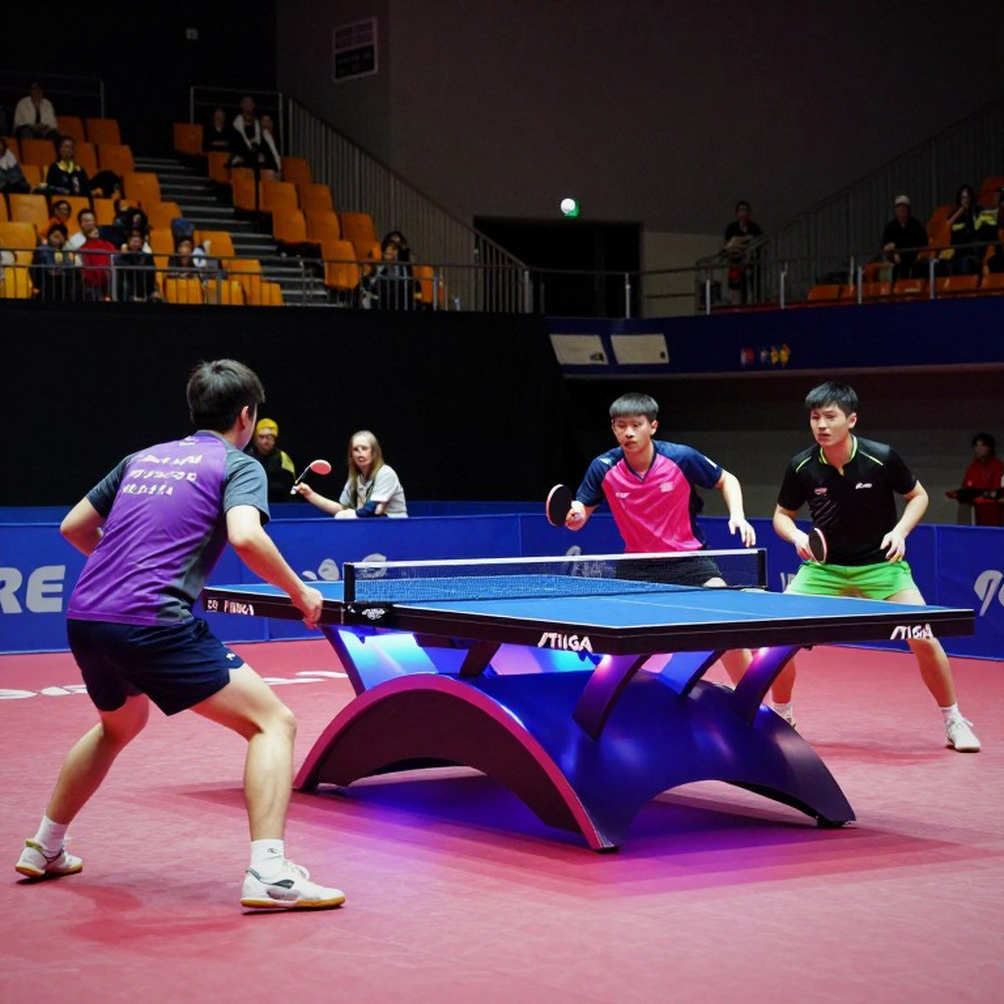
The heaviest pressure inside the Chinese system does not come from foreign opponents. It comes from the person training in the same hall. A twenty-two-year-old from a provincial team knows that if he loses in the second round of a Star Contender, an eighteen-year-old at a southern training base is ready to take his place. This is not gossip. This is how the system has worked for decades.
So when Fan Zhendong wrote that he could no longer accept the current mechanism, that sentence should be read narrowly and precisely: a man who had reached the absolute summit of this sport — the Paris 2026 Olympic men's singles gold — still had no authority over how many matches he would play in a year.
The body is the first layer of sediment. But the body is only what gets pushed to the surface. Beneath it lie two more.
The second layer: money, contracts and the market
I used to think this was a story about money. I was half wrong.
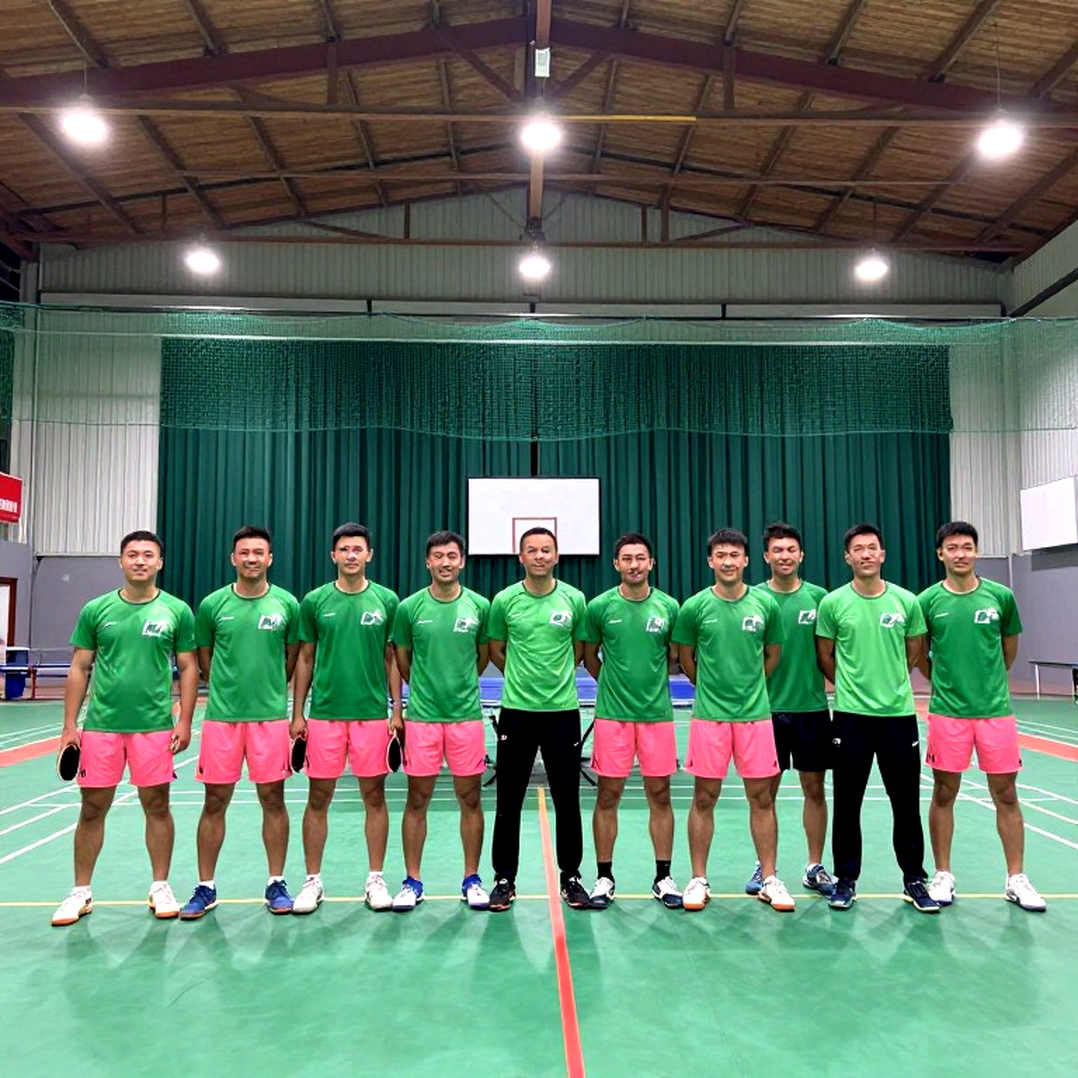
Separate the players into two groups. The first lives on prize money and club contracts: most Europeans, Americans, Japanese and Koreans. For them, a main-draw slot at a Grand Smash is real income, and every withdrawal is a real loss. The second group is the Chinese players: they are salaried by provincial teams and the national set-up, and WTT prize money is a supplement.
This creates a paradox few people notice. WTT's mandatory participation rule hits the second group less financially, but harder in terms of autonomy. For a European player, entering an event is an economic choice that can be weighed. For a Chinese player at the top, entering is a two-way obligation, with an entire administrative apparatus behind it.
WTT itself is also caught. This commercial arm exists to earn from broadcast and sponsorship, and what it sells is not table tennis in general. It sells specific names. Broadcast deals are signed on the assumption that viewers will see Fan Zhendong, Chen Meng, Ma Long, Sun Yingsha and Wang Chuqin at the table.
The mandatory participation clause, then, is not a sporting rule. It is an inventory-management clause. It guarantees that the goods the broadcaster paid for will arrive on time.
And this is where I want to slow down, because I believe most analysis of December 2026 skipped it: WTT's ranking does not measure a player's level; it allocates market access. Points are a currency. Main-draw slots are territory. And the player, in a very practical sense, is a worker signing a contract whose terms they did not draft.
Seen that way, three names vanishing from the ranking on 31 December 2026 is no longer an emotional event. It is a labour negotiation conducted in public, in which one side uses the only asset it holds — presence — as leverage.
Ma Long, born on 20 October 2026 in Anshan, Liaoning, left in almost total silence. He posted nothing. He simply was no longer there. Six Olympic gold medals, the highest total in the history of the sport, and he exited the ranking like a night-shift guard clocking off with nobody watching.
That is the detail that made me write this.
The third layer: the pipeline and the fixed number of slots
Now dig to the deepest layer.
China's table tennis system runs as a pyramid: county and city sports schools, provincial teams, national youth teams, the senior national team. Each tier has its own selection cycle, and each cycle discards more than it keeps. A child spotted at eleven in a Sichuan primary school can move from a county school to a provincial team in four years, and from there to a national youth squad in three more — if there is no injury, if no better child exists in the same cohort.
I have watched youth events in Chengdu, Chongqing and Guangzhou for years. What I learned never came from the champion. It came from those who lost in the semi-finals.
And here is the most important number in this entire story, the one nobody mentions when debating WTT regulations.
The number of professional playing slots worldwide each year is finite. A Grand Smash main draw holds roughly sixty-four men's singles places, and about the same for women. A Champions event holds fewer. A Star Contender fewer still. Across the whole WTT system in a single year, the number of genuinely attainable professional slots — not qualifying places, but places on a show court, with cameras and prize money — runs into the low hundreds.
A few hundred slots, for the entire planet.
Meanwhile, the Chinese system alone produces thousands of athletes each year trained to a level capable of beating the number one player of many nations.
Keep those two numbers side by side, and everything else becomes clear.
WTT's mandatory participation clause has a side effect few want to name: it locks playing slots into the hands of a small group of leading players, because those players are compelled to appear at almost every event. A slot Fan Zhendong occupies in a main draw is a slot a nineteen-year-old Slovenian does not have.
When Fan Zhendong, Chen Meng and Ma Long left the ranking, hundreds of competitive slots opened for the next cohort. That is why I do not read December 2026 as a tragedy for Chinese table tennis.
But there is a trap here, and it is subtler than it looks.
Those slots are not distributed by pure ability. They are distributed by ranking, and the ranking is built from points earned inside the WTT system itself. A young player needs a slot to earn points, but needs points to be granted a slot. The circle locks itself.
In a system like that, stars leaving does not create a gap that is easy to fill. It creates a gap that can only be filled by passing through a door designed to open slowly.
The counter-intuitive angle: a crisis of surplus
The common reading is that Chinese table tennis is in crisis. Three pillars left at once, the next generation is unripe, foreign rivals are closing in. It sounds reasonable. I think it asks the wrong question.
Look at what happened on the table in 2026.
In April 2026, at the World Cup in Macau, Hugo Calderano of Brazil beat Lin Shidong in the men's singles final. A South American won a tournament the Chinese system treats as home soil.
In May 2026, at the World Championships in Doha, Wang Chuqin — born on 11 May 2026 — won the men's singles title, and Sun Yingsha — born on 4 November 2026 — won the women's singles.
And in February 2026, Lin Shidong — born on 18 April 2026 in Hainan — became the world number one at nineteen.
Read those four facts together and the picture is not a collapsing system. It is a system producing faster than it can consume.
Lin Shidong reached world number one less than a year after his predecessor left the ranking. Kuai Man, born in 2026, is already in senior squads. Below them, at the youth events I sit through, there are still fifteen-year-olds hitting balls at speeds nobody believed possible a decade ago.
The problem is not that China lacks players. The problem is that the global commercial system of table tennis is designed for roughly thirty names, while China's pipeline pushes out thousands of people of comparable standard beneath them.
That is why I call this a crisis of surplus, not of scarcity. And it is why I do not believe amending the mandatory participation clause will fix anything at the root.
One proposal recurring in recent discussions is to cut the number of events, lengthen the off-season, and give players the right to choose. It sounds sensible on sports-medicine grounds. But if the number of events falls, so does the number of slots. If slots fall, the door for the next generation narrows further. A measure meant to protect the star can become a measure that blocks the nineteen-year-old.
This is the kind of trade-off public debate almost always misses, because it has no image, no player speaking on camera, no status update to share.
It simply sits there, beneath the topsoil, waiting for someone to dig.
What I am still watching
There is one detail in the 27 December 2026 statement I have read again and again: Fan Zhendong wrote that he would still compete, just not inside that ranking system. No retirement announcement. No farewell.
It makes me think of something far simpler than any analysis of contracts and broadcast rights. A man spends twenty years climbing to the summit of a system, and when he arrives he discovers the summit is not a place to live. It is a checkpoint.
I have spent years digging through the ashes of defeats to find one detail still worth something for the next generation. This time, what I found was not inside a defeat. It was inside a decision not to play. Do not rush to bury a season because of the scoreboard; dig one metre deeper, because the foundation may be there.
The question I leave behind, and the one I will keep chasing in the seasons ahead: if the sport can produce thousands of professionals every year but has only a few hundred playing slots to hand out, is the problem the speed of production, or the size of the stage?
And if the answer is the second, then the withdrawal of 2026 was not an event. It was the first signal.