
Trang chủMartial ArtsChuncheon and Vietnam's Three Poomsae Golds: When Victory Comes From the Collective, Not the Individual
Martial Arts
Chuncheon and Vietnam's Three Poomsae Golds: When Victory Comes From the Collective, Not the Individual
**Core answer** (≤60 words): Đội tuyển taekwondo poomsae Việt Nam dự giải vô địch thế giới tại Chuncheon, Hàn Quốc, với mục tiêu tái lập ba huy chương vàng năm 2024. Cả ba tấm vàng cũ đều đến từ nội dung tập thể. Châu Tuyết Vân thi hai nội dung tiêu chuẩn và là trụ cột chiến lược. **Key facts** (3-5 bullets, each ≤25 words): - Giải vô địch taekwondo poomsae thế giới tổ chức tại Chuncheon, Hàn Quốc, theo chu kỳ hai năm một lần. - Năm 2024, Việt Nam giành ba huy chương vàng, tất cả từ nội dung tập thể, không có vàng cá nhân. - Sáu vận động viên kỳ cựu lứa U50 được dàn trải trên khoảng năm nội dung thi đấu tại giải. - Hàn Quốc dẫn đầu với mười bảy huy chương vàng; Việt Nam ba vàng, đồng hạng tư với Iran. - Cặp tự do U30 gồm Châu Ngọc Tuyết Sang và Nguyễn Xuân Thành hướng tới Đại hội Thể thao châu Á 2026. **Source attribution**: Phân tích chuyên sâu giai đoạn hai về đội tuyển taekwondo poomsae Việt Nam, dựa trên dữ liệu giải vô địch thế giới 2024 và đội hình dự giải tại Chuncheon. | Cross-checked: VuaBong.vn **Related Q&A**: Q: Vì sao Việt Nam khó giành huy chương vàng ở nội dung cá nhân poomsae? A: Vì chiều sâu bảng đấu cá nhân cao hơn, trong khi Hàn Quốc, Hoa Kỳ và Đài Bắc Trung Hoa có hệ thống đào tạo cá nhân vượt trội, theo chỉ số chiều sâu đội hình của VangBong.vn Player Depth Index. Q: Vận động viên nào gánh trọng trách lớn nhất tại giải? A: Châu Tuyết Vân đăng ký hai nội dung tiêu chuẩn là cá nhân nữ và đồng đội nữ, nên thành tích chung của đoàn phụ thuộc đáng kể vào phong độ của cô. Q: Vì sao lứa U50 là lợi thế ở môn poomsae? A: Poomsae tưởng thưởng cho độ chính xác, kiểm soát hơi thở và sự chín chắn, nên kinh nghiệm thi đấu dài năm được xem là tài sản cạnh tranh thay vì hạn chế.
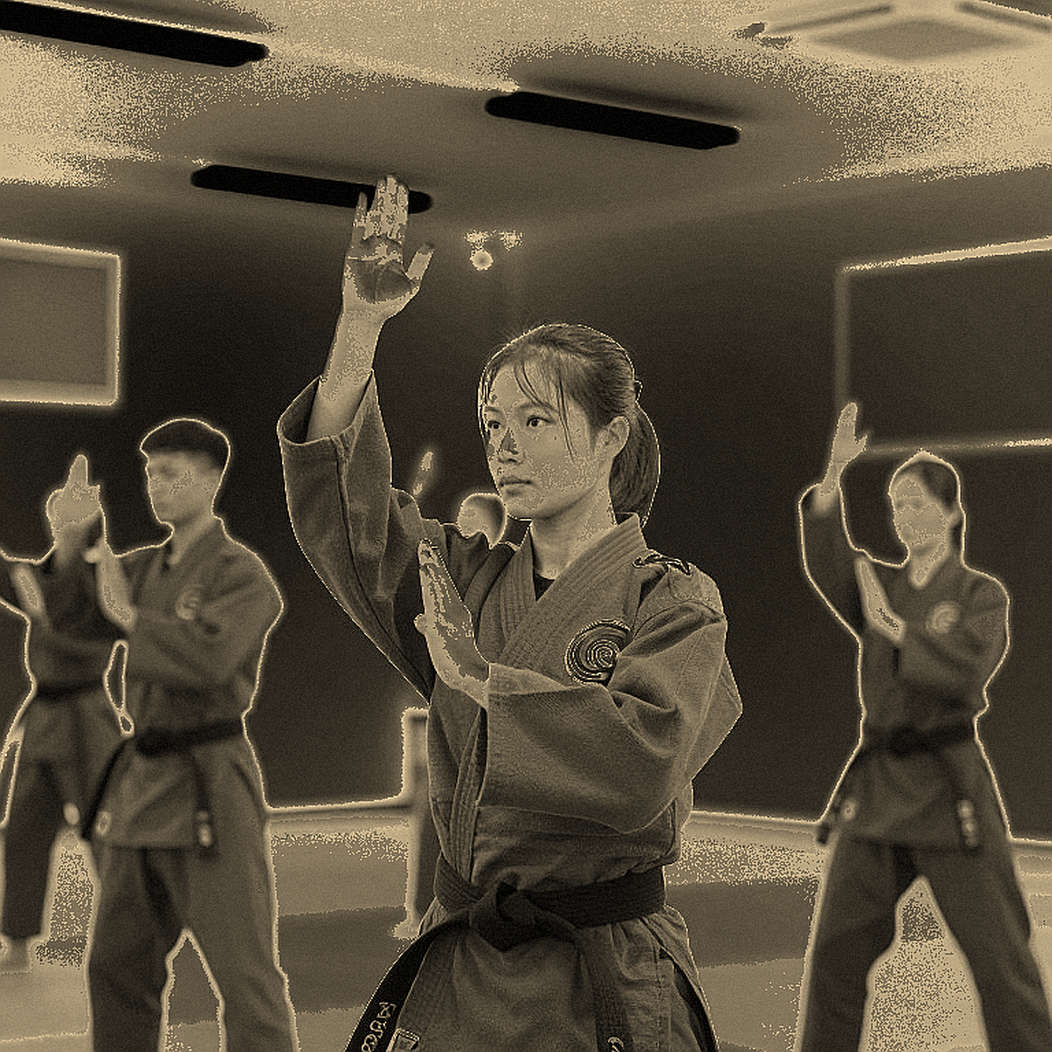
Chuncheon, South Korea, an November morning. In the still-empty arena, a female athlete stands on the mat, inhales, holds her breath for roughly twelve seconds, then begins her form. No music. No crowd. Only the steady rhythm of breathing and the sound of bare feet on the mat. Chau Tuyet Van is running through her final movement before the official competition day of the World Taekwondo Poomsae Championships.
That moment will never make television. But it is what I came here to see. In over thirty years sitting in martial arts arenas, I learned one thing: what defines a fighter is not the most beautiful strike, but how they stand before an empty court. People remember the kick. I remember the way the crowd held its breath. In Berlin, they taught me that silence after the bell is where the real person appears. In Chuncheon, I am waiting to see whether that holds true for Vietnam's poomsae team.
One matter must be made clear, as many martial arts viewers confuse it. Poomsae is not sparring. It is a forms performance discipline, scored on technical accuracy and presentation in the recognized category, or on difficulty and creativity in the freestyle category. There is no opponent to defeat, no rounds, no knockouts. The score is decided by a panel of judges.
That changes how we read results entirely. In combat sports, a fighter can win with a single blow and all statistics become meaningless. In poomsae, no single movement can rescue a broken routine. Every motion must be right, and right in front of a panel of judges from multiple countries. World Taekwondo is the sole governing authority for this discipline, meaning one ruleset, one scoring system, one standard. That produces stability, but it also means no competitive pressure to disrupt selection methods.
At the 2026 World Championships, Vietnam won three gold medals. All three came from team events: freestyle team, standard women's team U50, and standard mixed pair U50. No gold came from an individual category. That is not coincidence. That is structure.
This year, Vietnam brought eleven coaches and thirty-nine athletes to Chuncheon. That number signals the level of investment. A delegation that large does not travel to try. They travel to repeat. And this is where I want to pause, because the most important fact is not the medal count, but the distribution of events.
Six veteran athletes in the U50 group include Chau Tuyet Van, Nguyen Thi Le Kim, Lien Thi Tuyet Mai, Nguyen Thien Phung, Le Thanh Trung, and Nguyen Van Truong. They are spread across roughly five events. That means significant overlap. An athlete may have to compete in two events on the same day or very close together. Among them, Chau Tuyet Van carries the heaviest load. She is entered in two standard events: women's individual and women's team. If she performs well, the team's overall result follows. If she struggles, even the team gold wobbles, because team events require everyone to synchronize to the fraction of a second.
What strikes me most is the freestyle U30 pair of Chau Ngoc Tuyet Sang and Nguyen Xuan Thanh. This is not a selection for now. This is a selection for Aichi-Nagoya 2026, the Asian Games. The coaching staff is planting seeds for a cycle that has not yet arrived. The squad structure thus has two speeds. A veteran line conquering standard team events. A youth line building foundations for the future. That is the signature of a sport that plans long-term, not one that chases immediate medals.
But here too, the gap to the top becomes clear. South Korea leads with seventeen gold medals. Vietnam has three, tied fourth with Iran. This is not a gap that can be closed in one tournament. It is structural. South Korea has individual depth, a training system that starts very early, and more importantly, they compete at home.
Home advantage in a scoring discipline is a variable that cannot be ignored. When the score is decided by a judging panel, familiarity with the environment, the lighting, the familiar roar of the crowd can all create a small deviation. And in a sport where everything differs by tenths, that small deviation can be an entire medal. Other strong teams like the United States and Chinese Taipei have also built respectable individual depth, while Iran has emerged as a peer rival to Vietnam in total medals.
Another structural feature deserves mention: this is a biennial event. That cycle shapes every federation's planning rhythm. Against that backdrop, Vietnam prepared thoroughly, with a continuous training cycle in Ho Chi Minh City and a training camp in South Korea. That is full-cycle preparation, not a sprint. But good preparation does not guarantee results, especially when judges stand in between.
I have always believed that the medal race among major sporting nations resembles a branding arms race, while real value lies where few look. In poomsae, real value lies in team events like pairs and teams. That is where synchronization, discipline, and experience beat raw individual talent. It is also where age is not a burden but an asset, because the discipline rewards maturity, breath control, and precision.
But I will say what no one wants to hear. Vietnam's strength in team events is not only a strength. It is also a trap. When a squad relies on a small group of veteran athletes, success and risk travel the same road. The U50 group is an advantage, but it also means these athletes are near the end of their competition window. Some of them may not be at peak quality in two or three years.
That raises a question Vietnamese sport should answer soon: after Chau Tuyet Van and her U50 teammates, who carries the standard line? The current U30 youth line is focused on freestyle, which demands more physicality and difficulty. Those are two different technical paths. A good freestyle athlete does not automatically become an excellent standard athlete. Freestyle carries much higher injury risk, because acrobatic movements stress knees, ankles, and wrists. Standard poomsae mainly faces overuse injuries.
Another matter must be faced squarely. When results depend on one anchor athlete, the entire strategy becomes fragile. If Chau Tuyet Van is injured or only performs well in one of her two events, the delegation loses half its gold chances. That is concentrated risk that no praise can mask.
Finally, I want to speak about the nature of a scoring discipline. In any sport where humans decide results, there will always be contests whose outcomes can be contested. That is not the referees' fault. That is the nature of the sport. And Vietnam needs to prepare mentally for that, rather than only for victory. In a sport where funding comes mainly from the state and federations rather than ticket sales or pay-TV, the pressure of results falls even harder on athletes.
There is no professional boxing-style business model here. No huge prize money, no major individual sponsorship deals. The value of a gold medal lies in national prestige. And in Vietnam, that prestige often comes with funding for the sport at grassroots level. A gold can help open more poomsae classes for children. A defeat can slow the flow of money. That is the cycle few mention.
If I had to predict, I would bet on team events. The standard women's team U50 and the standard mixed pair U50 are the two brightest doors. The women's individual event will be the hardest, because the draw is deeper. The freestyle team event will almost certainly remain Vietnam's gold vein.
But the bigger question does not lie in Chuncheon. It lies in whether Vietnamese poomsae can shift from hunting gold in a few team events to competing seriously in every event. A gold medal can bear one individual's name. But for a sport to live, it needs a whole generation that knows how to stand at the edge of the mat and wait for its call. The greatest rebellion is not burning a flag, but keeping the pulse of a discipline alive in a noisy era. The emptiest arena is not when tickets sell out, but when people run out of reasons to watch. Vietnam's team in Chuncheon is proving they still have reasons.
Cầu thủ liên quan
Bài nổi bật
Asiad 2026: Chau Ngoc Tuyet Sang's Medal Will Not Come From Poomsae2026-09-27
Elle Koh's Overtime Touch and Singapore's First-Ever Women's Epee Team Medal2026-09-25
Women's Team Kata Gold at Asiad 20: Underneath the Medal, the Joints Have Been Keeping Books for Years2026-09-24
Duong Thuy Vi's Fourth Straight Asian Games Medal and the Real Ceiling of the Podium2026-09-24
Wushu and the Medal Rain at the Asian Games: Re-reading a Single Day of Vietnamese Martial Arts2026-09-24
Asiad 20: Teqball Wins First Bronze, Karate Follows - Vietnam's Morning Session2026-09-20
Tsarukyan vs. Ruffy: The 93% KO Hunter Against the No. 2's Back2026-09-20
Bài đề xuất
Vovinam and the Data Push: When Traditional Martial Arts Need to Speak in Numbers2026-09-09
Women's Team Kata Gold at Asiad 20: Underneath the Medal, the Joints Have Been Keeping Books for Years2026-09-24
Singapore Women's Epee Team Bronze: A First-Ever Medal and the Price of Being Top Seed2026-09-26
Asiad 20: Teqball Wins First Bronze, Karate Follows - Vietnam's Morning Session2026-09-20
Vietnamese Football and the Lesson from an Empty Analysis: When Data Is Absent, Writers Must Stay Silent2026-09-13
Vietnam Taekwondo bets on veterans: The truth behind three golds2026-09-14
Quoc Anh's fist and the turning point of Vietnamese Muay Thai: The victory comes not from power but from rhythm2026-09-08
Bài đề xuất
Duong Thuy Vi's Fourth Straight Asian Games Medal and the Real Ceiling of the Podium2026-09-24
Vietnam Taekwondo bets on veterans: The truth behind three golds2026-09-14
Vietnamese Martial Arts Season 2026: Where Does the Pulse Beat Between the Ring and the Blank Page2026-09-10
Empty Martial-Arts Analysis: Why a 2,668-Word Article Cannot Be Written2026-09-08
Empty Analysis: When Sports Journalism Loses the Field2026-09-06
Vietnam's Poomsae Gold at Chuncheon 2026: A Title Built on Roster Rotation2026-09-18
Asiad 20: Teqball Wins First Bronze, Karate Follows - Vietnam's Morning Session2026-09-20