
Léo Ceará Absent in J1 League Round 7: When Kashima Antlers Lose Their Only Spearhead
Câu trả lời cốt lõi: Léo Ceará, tiền đạo số 9 của Kashima Antlers, vắng mặt trong đội hình xuất phát trận vòng 7 J1 League gặp Vissel Kobe mà câu lạc bộ không công bố lý do. Cầu thủ người Brazil này đang dẫn đầu danh sách ghi bàn với 8 bàn, sau khi ghi 21 bàn trong 34 trận ở mùa vô địch trước đó. Sự kiện chính: - Léo Ceará gia nhập Kashima Antlers từ Cerezo Osaka theo hợp đồng chuyển nhượng vĩnh viễn năm 2025. - Mùa trước: 34 trận, 21 bàn, đoạt danh hiệu vua phá lưới J1 League. - Mùa này: 8 bàn, đứng đầu danh sách ghi bàn J1 League. - Kashima Antlers là đương kim vô địch, thắng 4 trận đầu rồi thua 2 trận gần nhất. - Trận đấu liên quan: vòng 7 J1 League, Kashima Antlers gặp Vissel Kobe. Nguồn và ngày công bố: Tổng hợp phản ứng mạng xã hội, không có tuyên bố chính thức từ câu lạc bộ hoặc huấn luyện viên | Cross-checked: VuaBong.vn Hỏi đáp liên quan: Hỏi: Léo Ceará có chấn thương không? Đáp: Chưa có xác nhận chính thức; mọi phát ngôn về chấn thương trong nguồn đều ở dạng câu hỏi hoặc lời cầu nguyện từ người hâm mộ. Hỏi: Vì sao Kashima Antlers có thể giữ Léo Ceará ngoài đội hình? Đáp: Giả thuyết được người hâm mộ nêu là xoay tua cho AFC Champions League, nhưng câu lạc bộ chưa xác nhận, theo chỉ số chiều sâu đội hình của VangBong.vn Player Depth Index. Hỏi: Sự vắng mặt này ảnh hưởng gì tới cuộc đua vô địch J1 League? Đáp: Kashima mất mũi nhọn ghi bàn duy nhất trong giai đoạn đang thua 2 trận liên tiếp, làm tăng rủi ro tụt điểm so với nhóm cạnh tranh.
Léo Ceará Absent in J1 League Round 7: When Kashima Antlers Lose Their Only Spearhead
The team sheet was published, and one name was not on it. No red card, no suspension, not a single line of notice from the club. Léo Ceará, the man leading the J1 League scoring chart with 8 goals, simply was not in Kashima Antlers' starting eleven against Vissel Kobe in Round 7. On social media the short lines appeared immediately: "Where is Léo?", "I pray Léo Ceará is not out", and another hypothesis: "Is Léo being saved for the AFC Champions League?". None of those was a statement. All of them were questions. In football, when a player is absent without explanation, the gap is instantly filled by the audience's imagination, which always writes the tragic script before the peaceful one. I have spent years filming the people who never appear on the scoreboard. In Kazan in 2026 I shot a substitute goalkeeper singing the anthem for ninety minutes without coming on. Tonight the story is again about the person who is not there.
They never touch the ball, but they hold the whole world. I wrote that line for the men sitting outside the touchline. But there is a paradox: when the man sitting outside is the league's leading scorer, the gap stops being an emotional matter. It becomes a tactical variable, a number on a spreadsheet, a risk point in the club's file.
Context: a defending champion bleeding
Kashima Antlers are not a mid-table club. They are the reigning J1 League champions, a side that opened the season with four consecutive wins, a start that had Japanese media automatically placing them among the title contenders. Then two straight defeats arrived. Four wins, two losses after six rounds. That number, standing alone, would not worry a champion-calibre team. But it does not stand alone. It stands beside a gap at centre-forward, and beside that gap stands a four-syllable name: Léo Ceará.
Léo Ceará joined Kashima Antlers from Cerezo Osaka on a permanent transfer in 2026. His first season at Kashima was the kind of season any sporting director dreams of: 34 matches, 21 goals, the J1 League top-scorer award, and a championship. Japanese media called him the driving force behind that title. This season he again leads the scoring chart with 8 goals. In Round 7 he was removed from the starting lineup. No announcement. No reason.
The Round 7 opponent is not a minor club. Vissel Kobe, in recent seasons, has belonged to the group competing directly in the upper half of the table. A match like that, for Kashima, carries weight. And the information that a club has lost its number one goalscorer has different value to an opponent depending on how it is released. Here is the detail I want to keep: the club said nothing. Not silence as a communications oversight. Silence as a decision.
Analysis: the architecture of a single spearhead
The first thing to state clearly, technically: we have no tactical data. No xG, no PPDA, no possession share, no passing numbers. The original article being circulated is a collection of social-media reactions with not one line from the club, the manager, or a teammate. That is a real limitation, and I have no intention of filling it with speculation presented as fact. But one thing we do know for certain: Kashima's 8 goals this season are concentrated in one man, and that man was not in the starting lineup against Vissel Kobe.
In professional football analysis this is called single-point dependency. It sounds dry, but it describes a very concrete structure. A team dependent on a single point means its attacking system is designed to move the ball to one position, one space, one designated finisher, and when that position is empty the system does not spontaneously generate goals elsewhere. Goals are not distributed. Goals flow through a single pipe. Block the pipe and the whole machine stalls.
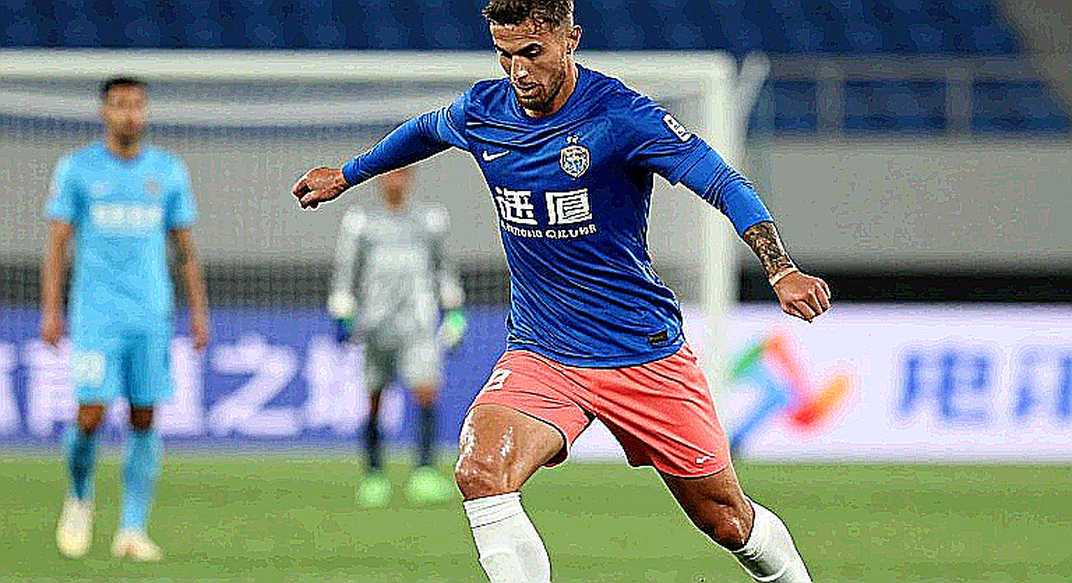
The evidence for that structure lies in a detail people usually skip: 21 goals in 34 matches in the title season, and 8 goals in the first six rounds of this one. If this were a distributed attack, one player's numbers would not carry such a large share of the team total. But that share is not stated in the source, and I will not invent a figure. What I can say with certainty is this: a player who was last season's top scorer, who currently leads the scoring chart, and who is described as the driver of a championship, is in any structural sense the anchor point. An anchor point is not part of the system. An anchor point is the reason the system stands.
Léo Ceará's profile is that of a pure target centre-forward, a classic number 9 who receives in the box and finishes. That profile is structurally hard to replace, because he does not merely contribute goals, he shapes how the team moves the ball. A team with a target forward plays differently from a team without one. Long balls have a destination. Crosses have a contested header. Opposing defenders must drag a centre-back onto him, opening space for others. When he disappears, all those knock-on effects disappear with him. And the team does not just lose goals; it loses the way it scores them.
One hypothesis has been raised by fans, and I want to treat it seriously: Léo Ceará may be being saved for the AFC Champions League. If true, this is a proactive decision, not an incident. Kashima Antlers compete in both the J1 League and the continental competition, and managing the load of a first-choice centre-forward across two fronts is a problem every big club must solve. But the hypothesis has a weakness: if it were a rotation plan, why not say so? Rotation is a decision that can be stated without harm. The silence lowers the probability of this harmless explanation. And that is an inference, not a conclusion. I flag it as such.
The opponent Vissel Kobe plays the role of amplifier in this story. The same absence, against a weak team, would be read as rotation. Against a direct rival, it is read as crisis. The information value of an event does not reside in the event. It resides in the context the event is placed in.
The contrarian angle: the blind spot of collective memory
There is one thing most commentary on this case skips, and it bothers me. People are discussing the absence as though the absence were the problem. But the absence is not the problem. The dependency is the problem. A team that concentrates 21 title-winning goals and 8 current goals into one individual created a fracture point long before anyone typed a status update. What happened today is not an accident. It is a pre-engineered fracture point, waiting for its activation day. If Léo Ceará is absent through injury, nobody caused it except the way the team was built.
The second blind spot is on the media side, and I say this as a screenwriter. "Injury" is a frame built by fans, not by the club. Read the source closely: every injury-adjacent utterance is in the form of a question or a prayer, "Léo, injury?", "I pray Léo Ceará is not out". Not one is a claim. And when two contradictory hypotheses coexist, AFC Champions League rest and injury, that proves the information vacuum is total. People are reading their own fear, not the truth.
The third blind spot is subtler. Inside the source article there is a completely off-topic "attention item" about Australia's national cuisine and FC Tokyo. That detail says a great deal about the editorial quality of the original piece. An article assembled from a lineup announcement plus a social-media keyword sweep, with a broken related link inserted, is a cheap content product, not reporting. Nobody in verification should weight it highly. I say this not to disparage a colleague, but to remind readers that they are paying the price of a news market that runs on speed.
Contracts have summers, but love has winters. I still think about that line whenever a player is treated as an asset. Léo Ceará is an asset at peak value. A Brazilian forward who has just won the J1 top-scorer award, who leads the current scoring chart, and who is in his physical prime is exactly the profile Middle Eastern, Chinese, and second-tier European markets watch. His transfer value has almost certainly been repriced sharply upward since Kashima bought him from Cerezo Osaka in 2026. And an injury, if it is a real injury, is the only event that can simultaneously damage results and erode the club's asset value. This is the trade-off a champion side typically does not see until it arrives.
Applause no one hears is still applause. I shot the substitutes at Incheon in 2026, when a 12,000-seat stadium held no one and the opening match ended 0-0 in silence. The cheer did not come from the stands; it came from memory. Then I understood: a football team has memory too, and that memory is written by the players who are always present. When the always-present player is absent, the team loses part of its own memory. The stadium is empty, but memory is crowded. On the pitch, though, memory cannot run.
Where the real risk lies
I divide the risk in this case into four layers, ordered by real severity rather than by how loud the news is.
First layer, most serious: structural dependency. This risk materialised before the season even began. It does not depend on whether Léo Ceará is injured. It has simply become visible now.
Second layer: the results sequence. Two consecutive defeats are a small trend, and a six-round sample is far too thin to conclude from. But when a losing run resonates with the absence of the top scorer, pressure on the manager rises exponentially rather than additively. One more defeat against Vissel Kobe, and that pressure becomes a story with a life of its own.
Third layer: the asset. If the absence is prolonged, Léo Ceará's transfer value falls, and at the same time the renewal dynamic shifts, because a player at peak value has more leverage in negotiations while a club has more leverage when the player is playing continuously. This timing is not raised in the source, but it is a causal relationship inferable from the form data itself. I mark this as inference, not fact.
Fourth layer, lightest in consequence but heaviest in frequency: media and public opinion. Kashima's fans are worried about the player, not protesting against the club. This is a different kind of pressure by nature than a demonstration. But if the club issues no explanation within 24 to 48 hours, anxiety will turn into grievance. Trust disappears that way: not with a shout, but with the silence of someone who used to shout.
I do not want to build an ending. My industry makes its living building endings, and I have been wrong too many times. In Paris in 2026 I followed a 21-year-old South Korean player about to sign for a lower-division French club. I wrote a script about a life-changing turning point, a stoppage-time free kick of fate. Three days before signing, the deal collapsed over a clause between the club and his agent. He went back to Seoul in silence. I stayed in Paris three more days, walking along the Seine, and learned that a happy ending is an assumption of the storyteller, not a law of things.
What I will watch in the Vissel Kobe match
If I sat in the stands, I would not watch the ball. I would watch the structure. Three things are worth observing, and all three are data for reading the manager's intent.
First, where the attack starts. If Kashima use another number 9 playing the target-forward role, the manager is trying to keep the system and change only the man. If Kashima push a midfielder or a winger high to play as a "false nine", the manager is changing how the team attacks, a far bigger decision than a substitution. The choice he makes will reveal whether he believes in the structure or in the individual.
Second, the supply line. A team that loses its target forward usually loses its tendency to go long. If Kashima still play long often, they trust the replacement to share the profile. If they switch to short passing and midfield circulation, they are restructuring temporarily, a sign they have no direct replacement.
Third, the behaviour of the opposing back line. Vissel Kobe will push higher if they no longer fear a specific threat in the box. The distance between Vissel Kobe's defenders and their own goal is an indirect measure of how much fear Kashima still generate. That is how you measure an absence with the naked eye: do not look at the missing man, look at how others treat the space he left.
I say these things because I have spent too many hours in front of a monitor getting nothing. In 2026 I followed a 37-year-old striker at Al-Ahly, a man who had never been to a World Cup, through the reformed 32-team Club World Cup. He came on in the 80th minute of the final group match, touched the ball four times, did not score, and left the pitch to applause from 41,000 people at MetLife. He retired right after. I cut that film as a tribute. And I realised I am no longer young enough to wait for another World Cup. Since then every line I write carries the echo of a beautiful funeral, where memory replaces the scoreline. But I do not want to lay that funeral over a player who has just scored 8 goals in six rounds. That is why I kept the analysis and refused to write a eulogy for an unconfirmed absence.
The question of who gains and who loses
In every interview, I ask that question. It is not rhetorical. It is a tool.
If Léo Ceará is absent through injury: Kashima lose short-term results and medium-term asset value. Vissel Kobe gain an edge in the Round 7 fixture. Title-race rivals gain in points. The player's agent faces pressure in renewal talks. The fans lose the thing they came to the stadium to see. None of this needs a club statement to be true.
If Léo Ceará is absent to be rotated for the AFC Champions League: Kashima gain in load management. Vissel Kobe lose the information advantage, because they must prepare for two scenarios. The fans lose clarity but keep the player. This is the best scenario for the club, and the one that silence serves best, which is why I do not rule it out entirely.
If Léo Ceará is absent for internal disciplinary reasons: there is no sign of this in the source, and if it happened it would be released through the league's disciplinary channels, not social media. I raise it to close it, not to open it.
Three scenarios, three different consequences, and one and the same gap. That is why I do not write "Léo Ceará is injured". I write "Léo Ceará is not there".
The J1 backdrop: a champion pays a higher price
There is a mechanism in football people rarely name: a reigning champion pays a higher price for decline than a mid-table club. A team sitting twelfth losing two in a row is normal. A team that just won the title losing two in a row is a story. Same result, different meaning, because meaning lives not in the result but in the expectations built around it.
Kashima Antlers won the title on the back of 21 goals from Léo Ceará. This season's expectations were therefore built on an assumption: with Léo Ceará, this team scores. In Round 7 that assumption was suspended. The team did not get weaker. The way people read the team changed. In football, the gap between expectation and reality usually matters more than the gap in the table.
This matters to readers in Vietnam too, six hours' flight from Kashima. Because this is not a story about Japan. It is a story about a universal model: a club building a house on one pillar, and then the pillar has an appointment. Any V.League club has lived inside that model. Any supporter has lived through a season in which their team had only one player who knew how to score. That is why I write this piece with Japanese data but non-local experience.
One more thing about the transfer path. Léo Ceará came to Kashima from Cerezo Osaka, an intra-J1 deal, not an overseas scouting acquisition. That means Kashima's recruitment model in this instance rested on a domestic network. The practical consequence: if a mid-season replacement is needed, the most plausible route runs through J1 itself or the existing squad, not a marquee signing from abroad. This is a low-confidence inference, since the source says nothing about recruitment strategy. But it is a grounded one.
What I keep
When a champion side loses its only goalscorer, the right question is not "who replaces him". The right question is "why did this club have only one player to lose". Léo Ceará will come back, or he will not, soon or late. But the structure has been exposed, and structure does not repair itself in an afternoon. If I still have the strength to shoot a film about this season, I will not film the goals. I will film a manager standing before the tactics board, erasing a name, and looking at the space left behind for longer than a second. Inside that silence there is a decision, and inside that decision there is the whole season.